What James Webb Reveals About Cosmic Dawn
Team Ilm Ora · 24 October 2026
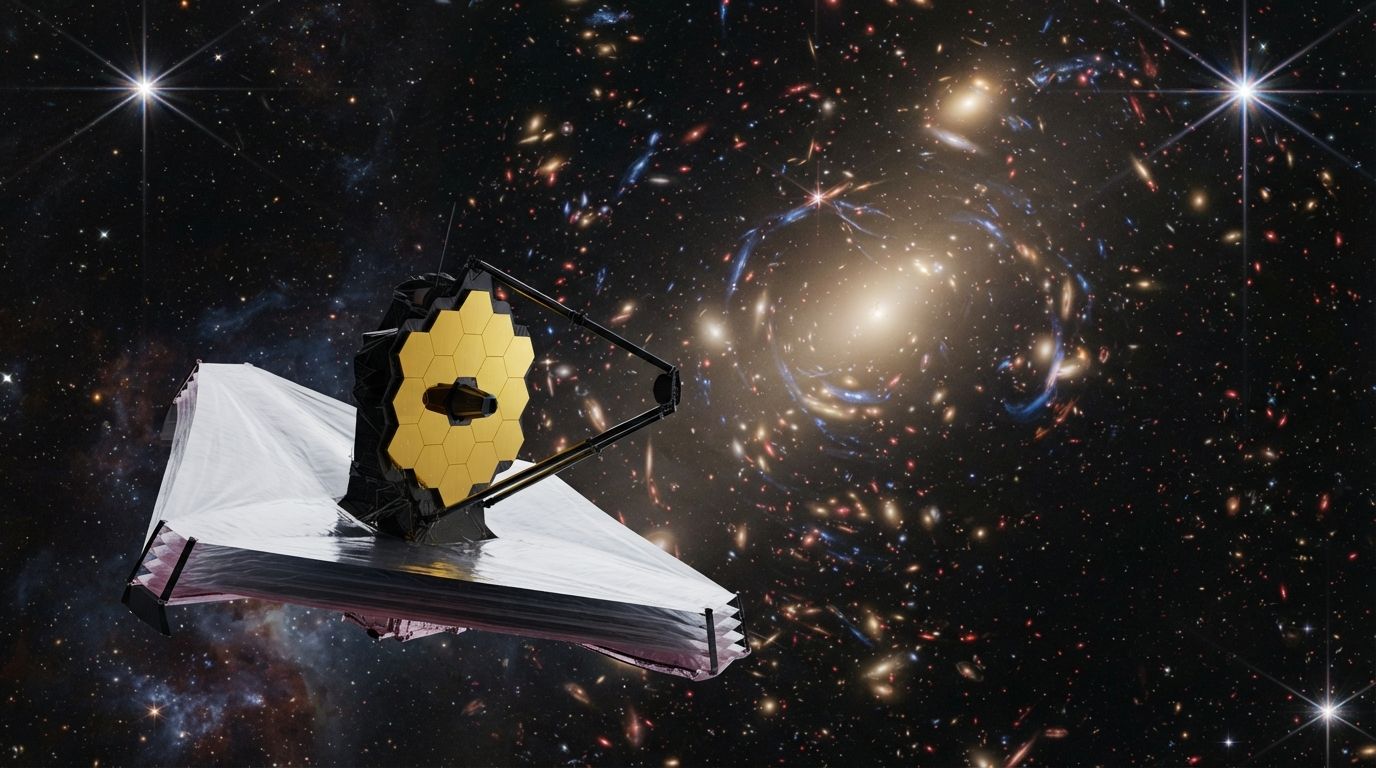
When the James Webb Space Telescope launched into orbit, astronomers hoped it would provide clearer infrared views of distant planetary atmospheres and stellar nurseries. What it has achieved since then has completely rewritten modern cosmological textbooks. By peering through thick clouds of interstellar dust and capturing ancient starlight traveling across space for over thirteen billion years, the telescope has detected record-breaking galaxies, such as the ultra-luminous MoM-z14 and JADES-GS-z14-0, shining just 280 to 290 million years after the Big Bang. As discoveries through 2026 continue to challenge theoretical models with massive galaxy clusters, early chemical enrichment, and complex dark matter structures, Webb remains our most vital scientific window into the elusive cosmic dawn.
Peering Back Through Time With Infrared Vision
To understand how the James Webb Space Telescope looks back into the history of the universe, we must examine the finite speed of light. Because light travels at a fixed speed across the cosmos, looking at distant objects means seeing them exactly as they were when that light first left them billions of years ago. However, observing the earliest moments of the universe introduces a major physical obstacle known as cosmological redshift. As the universe expands over billions of years, the fabric of space itself stretches. This stretching action physically elongates the wavelength of light traveling across it. Ultraviolet and visible light emitted by the first stars is stretched all the way into the infrared spectrum by the time it reaches our solar system. While older instruments like the Hubble Space Telescope were optimized for visible light, Webb is equipped with massive gold-plated beryllium mirrors and ultra-sensitive infrared sensors cooled to cryogenic temperatures. This specialized engineering allows Webb to pierce through opaque cosmic dust clouds and capture ancient infrared starlight that no previous human instrument could detect.
Discovering Galaxies That Challenge Cosmic Models
Since its deployment, Webb has shattered previous cosmological timelines, forcing astrophysicists to completely rethink how the universe evolved in its infancy. Standard theoretical models predicted that the earliest galaxies formed after the Big Bang should be small, dim, and primitive clumps of gas, slowly gathering mass over billions of years. Instead, Webb revealed massive, shockingly bright galaxies packed with mature stars and heavy chemical elements shining just a few hundred million years after the universe began. Discoveries like the record-breaking MoM-z14 and JADES-GS-z14-0 galaxies measure over sixteen hundred light-years across and exhibit intense ionized gas emissions, including oxygen. Finding heavy elements so early in cosmic history proves that massive stars formed, matured, and exploded in supernova blasts much faster and more violently than current physical models ever anticipated, turning our understanding of early galactic assembly upside down.
Unraveling Atmospheric Secrets and Dark Matter
Beyond exploring the early universe, Webb is transforming our understanding of planetary systems and cosmic architecture. By utilizing a technique called transmission spectroscopy, astronomers analyze starlight filtering through the atmospheres of alien exoplanets as they transit in front of their host stars. This sensitive analysis detects water vapor, carbon dioxide, methane, and complex organic weather patterns on distant worlds light-years away from Earth. Furthermore, by mapping how massive galaxy clusters bend and distort background starlight through a phenomenon known as gravitational lensing, Webb provides unprecedented clues about the distribution of invisible dark matter. This invisible gravitational scaffolding holds galaxies together, putting competing cosmological theories to rigorous observational tests.
A New Era of Astronomical Discovery
The James Webb Space Telescope stands as one of the greatest technological achievements in human history, fundamentally altering how we perceive our place within the cosmos. Beyond resolving long-standing observational paradoxes, Webb's continuous stream of deep-space data provides an unprecedented observational bridge between early theoretical astrophysics and real, verified physical data. By capturing the faint, ancient whispers of the cosmic dawn, it reminds us how much beauty, complexity, and mystery remain waiting in the dark expanse of space, challenging future generations of scientists to refine our fundamental equations of cosmic evolution. Every new data point gathered by Webb pushes the boundaries of human knowledge further toward the very beginning of time, ensuring that our journey to understand the origins of matter, stars, and life itself remains an active, evolving endeavor.
By building machines that capture light from the beginning of time, humanity transforms our deepest cosmic curiosity into undeniable scientific knowledge.