The Physics of Orbit: What Starship’s Fourteenth Test Flight Means for Spaceflight
Team Ilm Ora · 30 September 2026
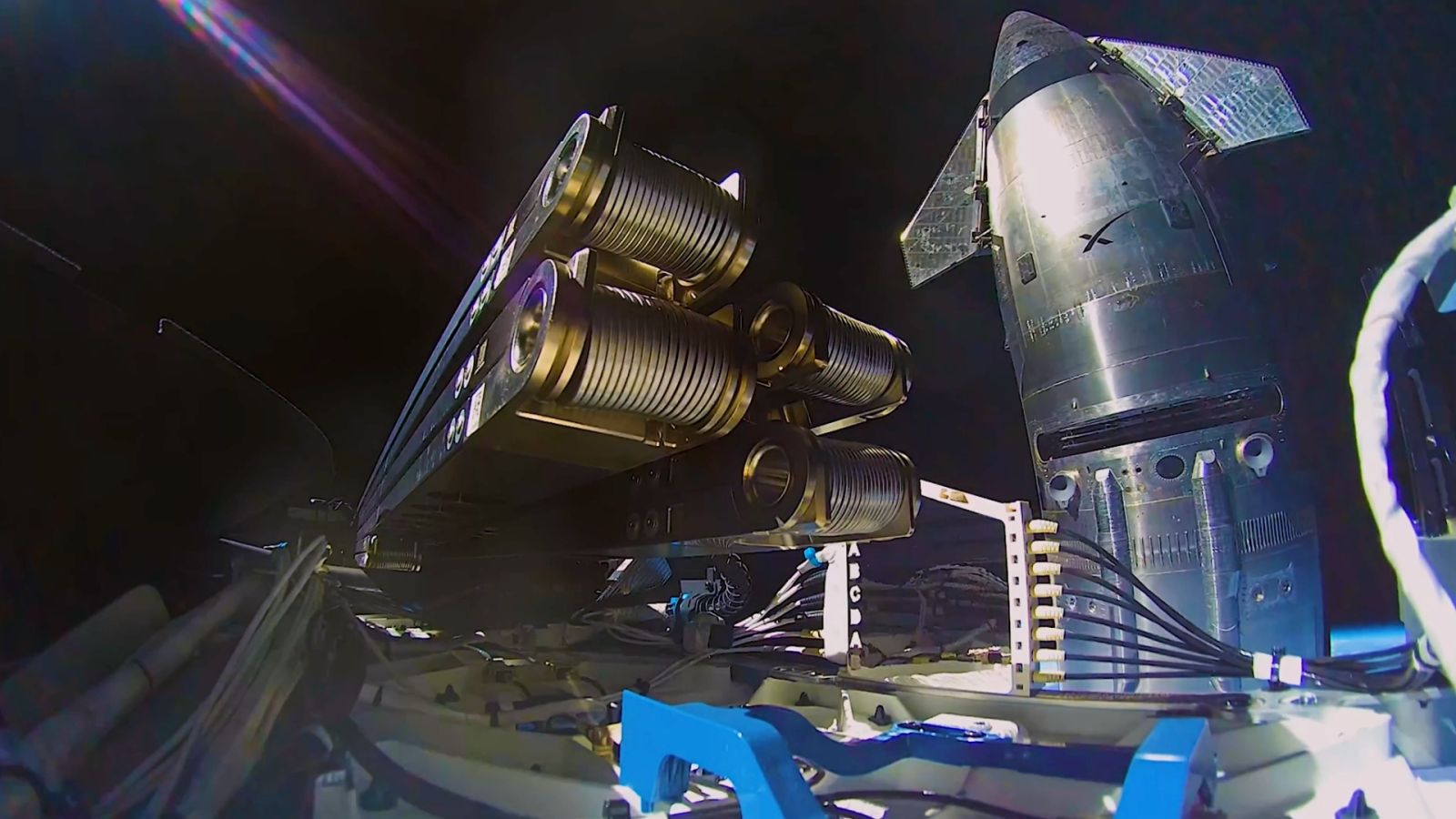
On September 28, 2026, the largest and most powerful launch vehicle ever constructed achieved a historical precedent. SpaceX's Starship vehicle successfully reached stable Earth orbit during its fourteenth integrated test flight, deploying twenty-six next-generation Starlink communications satellites into space before returning to Earth. While earlier test flights demonstrated atmospheric staging, thermal protection resilience, and splashdown maneuvers, Flight 14 marked the first time the upper-stage vessel successfully delivered a commercial payload into an operational orbit. Reaching this milestone required overcoming a mid-flight engine anomaly, providing a real-world demonstration of rocket flight dynamics, orbital mechanics, and the engineering challenges inherent to deep-space logistics.
What It Actually Takes to Stay in Space
A common misconception about space travel is that rockets merely need to fly high enough to escape Earth’s gravity. In reality, gravity at an altitude of four hundred kilometers—where the International Space Station flies—is still roughly ninety percent as strong as it is on the ground. The true challenge of spaceflight is not getting up, but staying up, which requires attaining orbital velocity. To achieve orbit, a vehicle must accelerate horizontally until its sideways speed is so immense—approximately 28,000 kilometers per hour, or 7.8 kilometers per second—that as gravity pulls the vehicle down toward the ground, the curved surface of the Earth drops away underneath it at the exact same rate. The vehicle enters a continuous state of falling around the planet, known as free-fall. Prior to Flight 14, all previous Starship launches followed suborbital trajectories. In a suborbital launch, the rocket ascends beyond the boundary of space—defined internationally as the Kármán line at an altitude of 100 kilometers—but lacks the horizontal velocity required to remain there. Earth's gravity inevitably pulls the vehicle back down in an arc toward the surface within minutes or hours. On Flight 13 in July 2026, Starship released dummy payloads while on a suborbital path, causing both the ship and its cargo to re-enter the atmosphere and burn up over the ocean. Flight 14 represented a fundamental transition from an atmospheric leap to a true, permanent placement in space.
Analyzing the Ascent, Anomaly, and Deployment Mechanism
The flight sequence began at Starbase in South Texas, powered by the Super Heavy booster's thirty-three Raptor engines. These engines burn liquid methane and liquid oxygen in a highly efficient full-flow staged combustion cycle, generating over seventeen million pounds of thrust. Shortly after the second-stage Starship separated from the booster, the flight encountered a critical failure when one of the ship's six vacuum-optimized Raptor engines shut down prematurely. In classical rocketry, losing an engine during ascent often results in a catastrophic failure to reach orbit. However, modern launch vehicles utilize dynamic real-time trajectory adaptation. Flight computers calculated the lost thrust and burned the remaining operational engines for a slightly longer duration, expending extra propellant to ensure the ship attained the requisite 28,000 km/h orbital velocity. Once in orbit, Starship faced another engineering challenge: deploying cargo without traditional payload bay doors. Traditional rockets feature clam-shell fairings that split open and fall away into the ocean during ascent. Because Starship is designed to be fully reusable, its structure remains intact throughout the flight. Satellites are instead ejected through a narrow horizontal slot built into the upper hull, functioning similarly to a mechanical dispenser. During Flight 14, this mechanism deployed twenty-six Starlink V3 satellites into low Earth orbit. These V3 satellites represent a major leap in telecommunications capacity, utilizing phased-array antenna systems to transmit up to one terabit per second of internet data—ten times the bandwidth capacity of previous generations launched on smaller Falcon 9 rockets.
Re-Entry Physics and the Long Road to Full Reusability
Deploying satellites into orbit fulfills only half of Starship's intended design architecture. The ultimate goal of the system is rapid, full reusability, which requires the upper-stage vessel to survive atmospheric re-entry from orbital speeds. As a spacecraft re-enters Earth's atmosphere at Mach 25, the air in front of the vehicle cannot move out of the way fast enough. It compresses rapidly, creating a superheated shock wave of ionized gas, or plasma, that reaches temperatures exceeding 1,400 degrees Celsius. To protect its steel hull, Starship is covered in thousands of hexagonal ceramic heat shield tiles. On Flight 14, three of the deployed Starlink satellites carried high-resolution cameras that turned back toward Starship after separation, capturing detailed external imagery of the heat shield before the ship initiated its de-orbit burn. While the vessel successfully controlled its descent through the upper atmosphere and executed a soft controlled splashdown in the Pacific Ocean three hours after launch, it suffered structural failure upon impacting the water. Demonstrating a soft ocean landing is a critical milestone, but it remains distinct from catching the upper-stage vessel back at the launch pad using mechanical arms—a recovery maneuver already demonstrated on the Super Heavy booster, but yet to be attempted with the upper stage.
The Future of Orbital Logistics and Deep Space Exploration
The success of Flight 14 validates the core transport capability of Starship, yet several complex engineering obstacles must be solved before the vehicle can fulfill its primary assignments for NASA’s Artemis program. The most daunting of these is in-space cryogenic propellant transfer. Because a massive rocket burns almost all of its fuel simply escaping Earth’s gravitational well, it arrives in low Earth orbit with nearly empty tanks. To send a crewed Starship to the Moon or Mars, multiple automated "tanker" Starships must launch in rapid succession, docking with a primary depot vessel in orbit to transfer supercooled liquid methane and oxygen. This process—transferring thousands of tons of volatile fluid in zero gravity—has never been performed at scale. While Flight 14 has successfully answered whether a super-heavy weight class, single-hull reusable vehicle can reach orbit and deploy heavy commercial hardware, it initiates a new phase of operational testing. As regulators evaluate requests for increased launch frequencies and engineers refine thermal protection materials, Starship transitions from an experimental prototype to an active heavy-lift infrastructure. The ability to routinely deliver large payloads into orbit transforms space travel from an expensive, rare endeavor into a scalable, high-capacity transport system.
Reaching orbit shows that a rocket can get to space. The harder test is whether it can do it again and again, safely and cheaply. Flight 14 answered the first question, and the second is still open.