Postmodernism and the Death of Grand Narratives
Team Ilm Ora · 19 October 2026
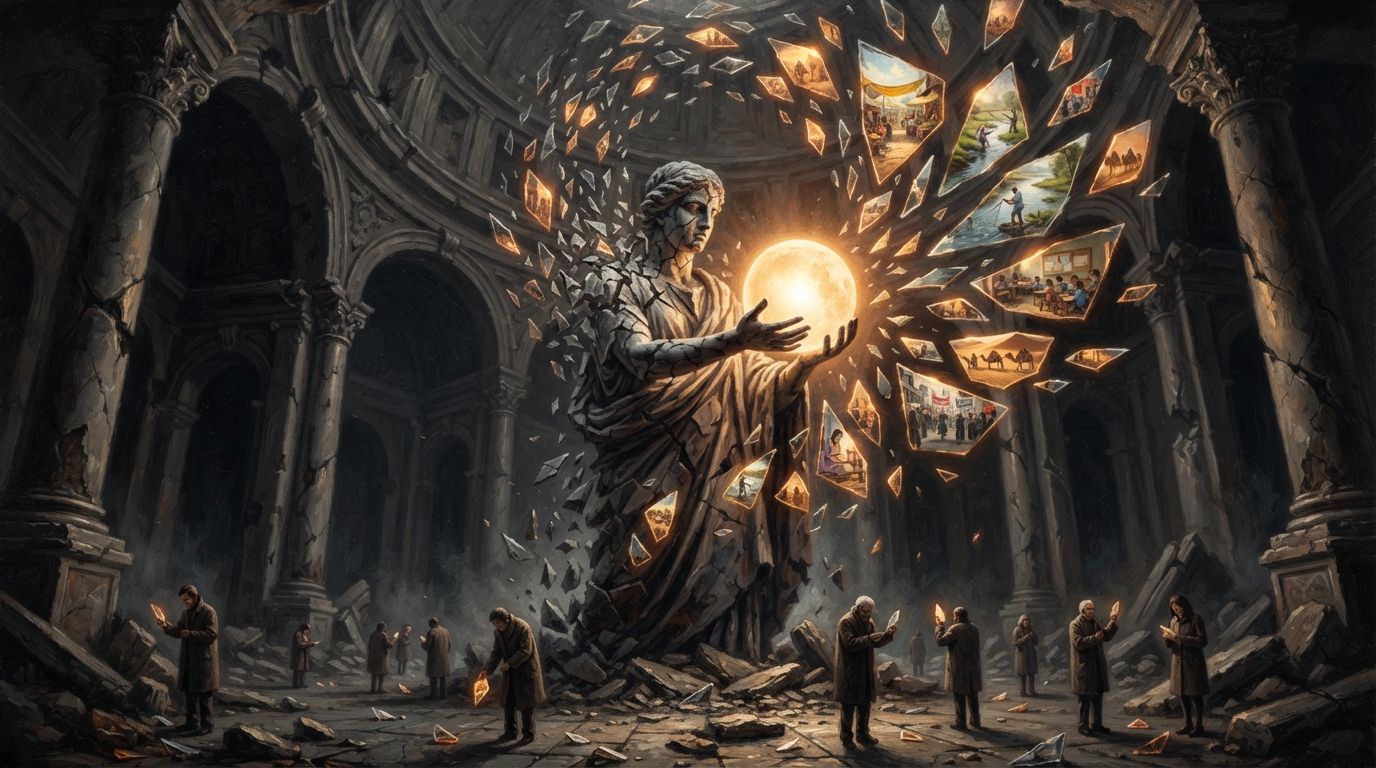
For centuries, human societies organized their moral, political, and scientific lives around overarching master explanations known as grand narratives or metanarratives. The Enlightenment argued that human history was an endless upward march of rational progress; Marxism claimed that historical class struggles would inevitably resolve into a stateless communist utopia; and various religious systems promised divine order and ultimate salvation. In the late twentieth century, philosopher Jean-François Lyotard declared that the modern era was over, defining postmodernism as a profound "incredulity toward metanarratives." Postmodern critique dismantles these absolute systems, warning that universal claims to absolute truth often mask hidden impulses toward institutional control and exclusion.
Deconstructing the Enlightenment Myth of Universal Reason
At the heart of postmodern philosophy is a deep skepticism toward the Enlightenment assumption that human reason is completely objective, neutral, and universal. Postmodern thinkers like Michel Foucault demonstrated that what any culture defines as "objective truth" or "rationality" is deeply entangled with dynamic power structures. Every historical era invents its own institutional vocabularies to determine who is considered sane or insane, law-abiding or criminal, expert or ignorant. Therefore, claims to universal truth are rarely neutral discoveries; they are often rhetorical tools used by dominant groups to legitimize their authority and marginalize alternative ways of knowing.
The Fragmentation of Reality and the Rise of Local Knowledge
By rejecting grand master narratives, postmodern philosophy shifts focus toward localized, pluralistic, and fragmentized human experiences. Rather than attempting to force all human history, culture, and ethics into a single universal theory, postmodernism celebrates diversity, complexity, and local context. It encourages critical questions about whose voice is being silenced when a dominant culture declares its own values to be "universal human nature." This deconstructive approach opened new intellectual space for post-colonial studies, feminist theory, and grass-roots cultural critiques that highlight previously ignored human perspectives.
The Hazards of Absolute Relativism in the Digital Era
While postmodernism provided valuable tools for dismantling authoritarian dogmas, it introduced serious philosophical challenges for modern democratic societies. Taken to its absolute extreme, postmodern critique can collapse into radical cynicism, where the very concept of objective truth is abandoned entirely. In our contemporary digital media environment, this hyper-skepticism has been weaponized by bad-faith political actors who claim that all facts are merely political propaganda, resulting in deep public cynicism, "alternative facts," and the erosion of shared democratic reality.
Rebalancing Critique with Shared Truth
Navigating the modern world requires balancing postmodern skepticism with a commitment to empirical truth. We can use postmodern tools to question institutional power without surrendering our belief in objective reality, building a society that values diverse perspectives while remaining anchored in shared facts.
Questioning institutional power is the mark of a healthy mind, but abandoning our belief in objective truth leaves us helpless against political deception.