
You Are Not One Mind. You're Two Nervous Systems Negotiating.
Team Ilm Ora · 12 September 2026
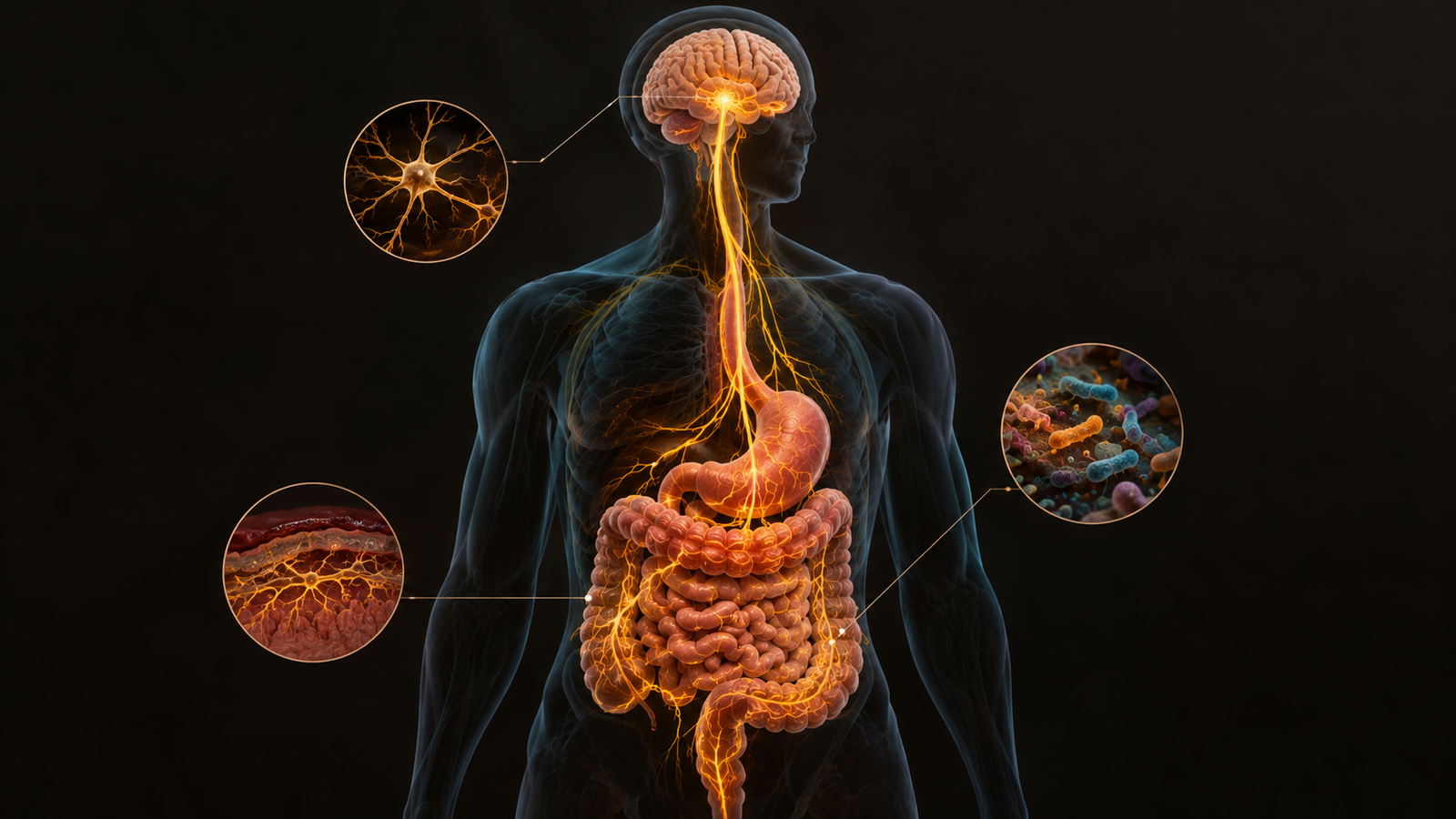
You probably picture your brain as the one place where decisions and moods actually get made. There's a second, largely independent nervous system sitting in your intestines right now, and solid experiments suggest it has more say over how you feel than almost anyone realizes
Meet Your Second Nervous System
Running through the walls of your entire digestive tract — from your esophagus down to the other end — is a nervous system with a name: the enteric nervous system, or ENS for short. It contains more than 100 million neurons (nerve cells), and by some estimates as many as 200 to 600 million — more than the neurons packed into your entire spinal cord.
Unlike most of your nerves, this system doesn't just wait around for instructions from your brain. It's built from two separate networks embedded directly into your gut wall:
The myenteric plexus, sitting between two layers of gut muscle, mainly controls peristalsis — the coordinated squeezing motion that pushes food through your digestive tract. About 30% of its own neurons are dedicated to sensing what's happening, not just moving muscle. The submucosal plexus, sitting closer to the gut's inner lining, mainly controls local blood flow, fluid release, and absorption.
Where did this system come from? During early development in the womb, most of these neurons start out as neural crest cells — the exact same type of cell that goes on to build parts of your brain and spinal cord elsewhere in your body. Early on, these cells migrate out from what will become your brainstem and travel all the way down, colonizing your entire gut. In other words: this "second brain" is built from brain-lineage cells that moved out and set up their own operation, far from home.
Because of this independence, isolated sections of intestine — physically cut off from any connection to the brain — will still contract in the same coordinated wave pattern used to move food along. Your gut was never fully under central command in the first place.
The Serotonin Fact That Changes the "Mood Chemical" Story
You've probably heard of serotonin as "the mood chemical" — it's the specific target of SSRIs, the most common type of antidepressant medication. Here's the detail almost nobody knows: an estimated 90 to 95 percent of the serotonin in your entire body is made in your gut, not your brain.
Before you jump to "so my gut controls my mood chemically" — it's more complicated, and more interesting, than that. Serotonin can't easily cross into your brain from the rest of your body; there's a protective barrier (called the blood-brain barrier) keeping the brain's own separate serotonin supply mostly walled off. So what does all that gut-made serotonin actually do? It drives the muscle contractions of digestion, adjusts how sensitive your gut is to being stretched or full, and activates nerve fibers that carry signals back up toward your brain. Your gut is running its own serotonin system, mostly for its own local purposes — but constantly signaling upward to the brain's separate system at the same time.
The Line to Your Brain Mostly Runs the Wrong Way
The main physical connection between your gut and your brain is the vagus nerve, running from your brainstem, down through your chest, into your abdomen. The obvious assumption is that your brain is in charge, sending instructions downward. The anatomy says the opposite: roughly 90% of the fibers in the vagus nerve carry information upward, from gut to brain — not from brain to gut.
This one fact explains something you've probably felt your whole life without knowing why: the nausea that shows up before a hard conversation, the stomach-drop that happens before your mind has even finished forming a thought, or the "gut feeling" you sometimes trust over careful reasoning. Those aren't just expressions. In that moment, your gut's nervous system is genuinely ahead of your conscious mind, physically sending signals your brain is only just starting to react to.
What Happens When You Remove the Bacteria: Germ-Free Mice
Some of the clearest proof that gut and brain are truly linked comes from experiments with mice raised in completely sterile conditions — no gut bacteria at all. These are called germ-free mice.
In a well-known 2004 study, researcher Nobuyuki Sudo and his team put stress on germ-free mice (a brief physical restraint) and measured their HPA axis — the body's central stress-hormone control system, which releases hormones like cortisol (in humans) or corticosterone (in mice) when you're under pressure. Compared to normal mice with regular gut bacteria, the germ-free mice had a much bigger stress-hormone spike, and lower levels of a brain-growth protein called BDNF, which is closely tied to how well the brain adapts to stress.
Here's the part that proves cause and effect, not just correlation: when researchers gave those same germ-free mice a single specific type of gut bacteria, called Bifidobacterium infantis, early in their development, the exaggerated stress response went back down to normal. Giving them a different, harmful type of bacteria (a strain of E. coli) did not fix it — it actually made the stress response worse. This tells us it wasn't just about "having some bacteria." It was about which specific bacteria were there. Timing mattered too: giving the good bacteria later in development didn't work the same way, pointing to a specific early-life window when gut bacteria help set up the stress system.
Swapping Personalities Between Mice
If the germ-free experiments show what happens with no bacteria at all, a second set of experiments shows what happens when you swap bacteria between two individuals.
In a 2011 study, researcher Premysl Bercik and his team at McMaster University worked with two mouse breeds known for having opposite, stable personalities: BALB/c mice, naturally timid and anxious, and NIH Swiss mice, naturally bold and adventurous. They raised germ-free versions of both, then gave the germ-free BALB/c mice gut bacteria from bold NIH Swiss mice — and gave germ-free NIH Swiss mice gut bacteria from timid BALB/c mice.
The result: the naturally timid mice became noticeably more adventurous and exploratory after getting the bold mice's bacteria, along with a rise in that same brain-growth protein (BDNF) in a brain region tied to learning and memory. The naturally bold mice became noticeably more cautious and hesitant after getting the timid mice's bacteria. The researchers also ruled out simpler explanations — this wasn't about inflammation or the autonomic nervous system — pointing toward a more direct signaling path between gut bacteria and brain function.
That's a controlled experiment showing personality-linked behavior transferring between animals, in both directions, along with their gut bacteria.
What This Should Change About How You See Yourself
To be clear: this doesn't mean your mood is simply decided by what you had for breakfast, and scientists still don't fully understand exactly how human personality connects to the human gut microbiome — most of the strongest proof so far comes from mice, and translating it directly to people takes real caution.
But here's what's now solidly established, from multiple independent research groups: your gut runs its own nervous system with real independence from your brain, most of your body's serotonin is made there rather than in your head, the main communication line between gut and brain carries more traffic upward than downward, and changing the bacteria living in an animal's intestine can directly change its stress hormones and even its exploratory behavior. You're not one central decision-maker with a digestive tube attached. You're two connected nervous systems constantly negotiating — and a real chunk of what feels like "your" mood or instinct may have started as a signal from well below your ribs.
Ninety percent of the traffic on the nerve connecting your gut to your brain travels upward, not downward. By the time you've finished deciding how you feel about something, your gut may have already told your brain what to think.