The Year Without Sun: The 536 CE Volcanic Winter and Late Antique Collapse
Team Ilm Ora · 17 October 2026
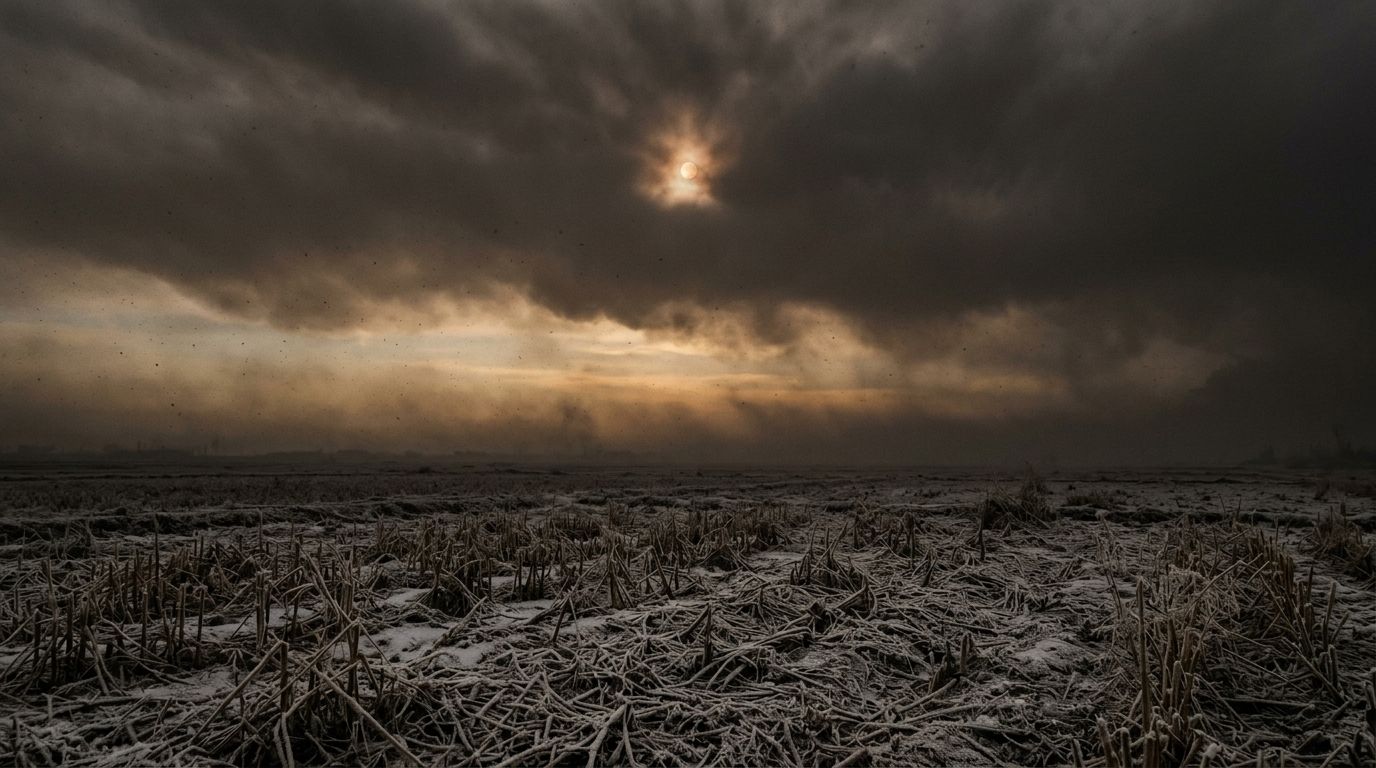
In the year 536 CE, the Byzantine historian Procopius recorded a terrifying phenomenon: the sun gave forth its light without brightness, looking like the moon in eclipse for an entire year. Across Europe, the Middle East, and East Asia, summer temperatures plummeted, snow fell during harvest months, and crops rotted in fields. For decades, historians treated these accounts as literary exaggerations. However, modern palaeoclimatology, combining high-resolution polar ice core chemistry with tree-ring density studies, confirms that 536 CE marked the onset of the coldest decade in two thousand years. This environmental collapse, known as the Late Antique Little Ice Age, was caused by massive volcanic eruptions that disrupted global climate systems and shifted human history.
Stratospheric Aerosols and Radiative Forcing
The physical driver of the 536 CE climate event was an explosive volcanic eruption that injected immense volumes of sulfur dioxide gas into the stratosphere. The stratosphere is the stable layer of Earth's atmosphere extending from roughly ten to fifty kilometers above the surface, situated above weather systems that would normally wash out atmospheric pollution through rain.
Once inside the stratosphere, sulfur dioxide reacts with water vapor to form microscopic droplets of sulfuric acid, creating a dense stratospheric aerosol haze. These aerosols act as a reflective shield, scattering incoming solar radiation back into space before it can reach the planet's surface. This process, known as negative radiative forcing, starves the lower atmosphere of solar energy. The initial 536 CE eruption was followed by secondary mega-eruptions in 540 CE and 547 CE, maintaining this volcanic haze layer for over a decade and dropping Northern Hemisphere summer temperatures by up to two degrees Celsius.
Reading Climate Records in Polar Ice Cores
To pinpoint the timeline and chemical makeup of these ancient eruptions, scientists extract deep polar ice cores from Greenland and Antarctica. As snow falls on polar ice sheets year after year, it traps atmospheric particles and bubbles of air, compacting into distinct annual layers of ice.
Near the top of the ice core, recent compacted snow represents modern decades. Moving deeper down into annual seasonal layers, scientists locate the precise chemical signature of the 540 CE and 536 CE volcanic eruptions. In these specific historical strata, ice cores display massive spikes in volcanic sulfate ion concentration. High-precision mass spectrometry allows scientists to examine microscopic volcanic ash particles, called tephra, embedded within the 536 CE ice layer. By matching the chemical trace elements inside these glass tephra shards to volcanic rock formations around the world, researchers identified candidate eruption sources in the Northern High Latitudes, including volcanoes in Iceland and North America.
Dendrochronology and Tree-Ring Growth Anomalies
While ice cores supply chemical data about volcanic atmospheric clouds, dendrochronology measures the precise biological impact on terrestrial ecosystems. Dendrochronology is the science of dating and analyzing annual growth rings in long-lived trees. Each year, trees form a new ring of wood tissue beneath their bark; warm, moist growing seasons produce wide rings of dense latewood cells, while cold, dry seasons produce thin, underdeveloped rings.
Tree-ring samples recovered from ancient Irish oaks, Scandinavian pines, and Siberian larch trees display near-zero ring growth beginning precisely in the summer of 536 CE. Microscopic examination reveals frost rings, which are damaged, distorted cell structures caused by sap freezing inside living wood during sudden summer cold snaps. The tree-ring data confirms that summer growth across Eurasia remained severely depressed for over fifteen years, providing physical proof of widespread, prolonged agricultural failure.
Societal Collapse, Famine, and the Justinian Plague
The environmental consequences of the Late Antique Little Ice Age triggered widespread social upheaval across Eurasia. Widespread crop failures caused severe famines across the Mediterranean basin, the Sasanian Empire, and China. Malnutrition weakened human immune systems across rural agricultural communities, creating vulnerable conditions right before a devastating medical crisis.
In 541 CE, at the peak of climate cooling, the first recorded pandemic of bubonic plague (the Plague of Justinian) struck the Mediterranean port of Pelusium in Egypt. Driven by the bacterium Yersinia pestis, the plague spread along maritime trade routes, killing an estimated twenty-five to fifty million people across the Byzantine world. The combination of agricultural collapse, economic collapse, and population decline permanently disrupted trade networks, destabilized empires, and marked the geopolitical transition from classical antiquity to the early Middle Ages.
The ice and trees remind us that human empires, no matter how powerful, remain subject to the delicate climate balance of our living planet.