Mastering the Indus: Ancient Hydrology and Metallurgy at Mohenjo-daro
Team Ilm Ora · 17 October 2026
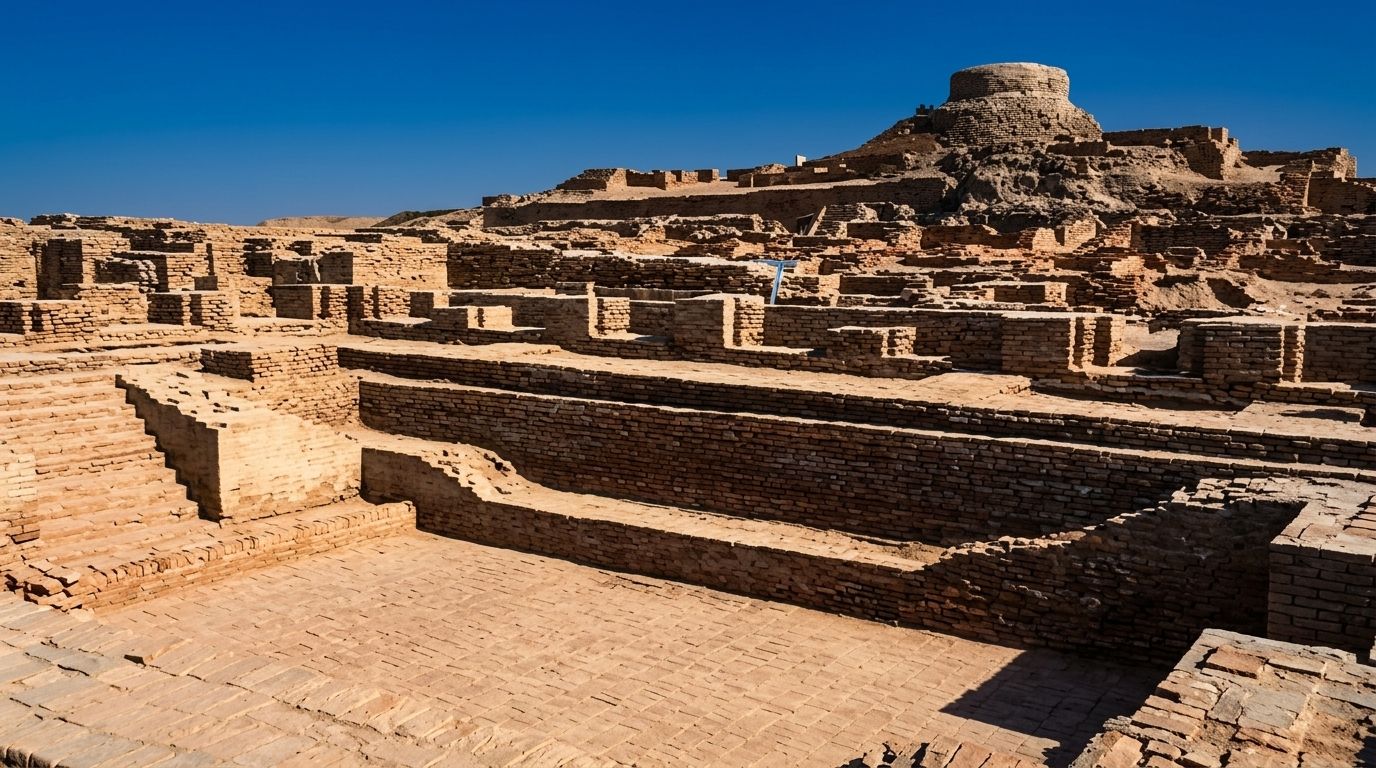
Constructed around 2500 BCE along the fertile floodplains of the Indus River in modern-day Sindh, Pakistan, Mohenjo-daro remains one of the world's earliest planned metropolises. While ancient Egyptian and Mesopotamian cities developed around monumental royal palaces and dynastic temples, Mohenjo-daro was organized around civic utility, public health, and environmental risk management. Recent multi-proxy archaeological investigations, combining sediment core carbon-isotope testing with ceramic petrography, demonstrate that Harappan engineers designed a modular city capable of surviving seasonal flood surges while supplying clean water and sanitation to thousands of residents.
The Civil Engineering of Standardized Masonry
The spatial foundation of Mohenjo-daro relied on strict modular grid planning and standardized building materials. Unlike contemporary ancient cultures that built primarily with sun-dried mud bricks, Harappan builders produced durable kiln-fired ceramic bricks manufactured to an exact ratio of 1:2:4 in depth, width, and length. This standardized geometry ensured uniform structural load distribution, allowing builders to construct multi-story residential blocks and deep retaining walls.
Kiln firing required heating raw alluvial clay to temperatures exceeding 1,000 degrees Celsius, altering the mineral structure of the clay to make it waterproof and resistant to water erosion. The city was constructed atop elevated artificial platforms built from packed earth and fired brick revetments. These massive platforms raised entire residential sectors above the high-water mark of seasonal Indus River floods, functioning as civil defense barriers that protected urban infrastructure during monsoonal overflow cycles.
Closed Sanitation and Hydro-Geomorphic Drain Engineering
Mohenjo-daro’s municipal water network represents the earliest known urban closed-sanitation system. Water supply was decentralized through a network of over seven hundred lined public and private brick wells, tapping into the local high water table. To dispose of wastewater, almost every home contained a dedicated bathing room constructed with finely fitted, water-tight brick flooring that sloped toward a wall exit. Wastewater flowed through gravity-fed channels into covered brick street drains running parallel to major avenues. The drain walls were sealed with mortar made from a mixture of natural gypsum, lime, and sand to prevent sewage from seeping into nearby wells. To maintain flow velocity and prevent sediment buildup, engineers built drains with gentle downward slopes and included covered brick inspection sumps at regular intervals. These sumps acted as settling basins where solid debris dropped out of suspension, allowing municipal maintenance crews to clear blockages without excavating whole streets.
Isotopic Profiling and Metal-Alloy Technologies
Recent geochemical and isotopic studies of metal artifacts uncovered in industrial sectors reveal that Harappan metallurgists possessed advanced alloy processing skills. Metallurgy involves extracting metallic elements from raw mineral ores through high-temperature reduction refining. Harappan artisans combined pure copper with controlled percentages of tin and arsenic, creating bronze alloys with enhanced structural hardness and lower melting temperatures. Lead-isotope analysis allows scientists to measure stable lead isotope ratios within copper tools, matching them to specific geological mining deposits. Isotopic fingerprinting proves that Mohenjo-daro imported raw copper ores from distant mines in Rajasthan and Balochistan, blending them in specialized urban craft workshops. Artisans used lost-wax casting, a technique where a detailed sculpture is sculpted in beeswax, encased in fine clay, fired to melt the wax away, and filled with molten bronze to produce precision cast tools, bronze statuettes, and standardized weights.
Climate Adaptation and the Urban Legacy
Soil core samples taken across the Indus floodplain indicate that the region experienced dynamic hydrologic shifts over centuries. Rather than being caught off guard by changing river channels, Mohenjo-daro’s urban layout underwent periodic cycles of structured rebuilding and elevation adjustments. Streets were systematically raised, and drainage channels were rebuilt at higher levels to keep pace with river silt accumulation on the plain.
The decline of Mohenjo-daro around 1900 BCE was not caused by sudden military conquest or single catastrophic events, but by long-term shifts in monsoonal rainfall patterns that weakened the regional agricultural base. Nevertheless, the urban engineering demonstrated at Mohenjo-daro set a global standard for municipal sanitation, modular construction, and hydrological planning that remains deeply relevant to modern civil engineering.
Long before modern municipal planning, the builders of Mohenjo-daro proved that the true measure of a great civilization lies in how clean it keeps its water and how well it protects its citizens.