How Organic Molecules Power OLED Screens
Team Ilm Ora · 19 October 2026
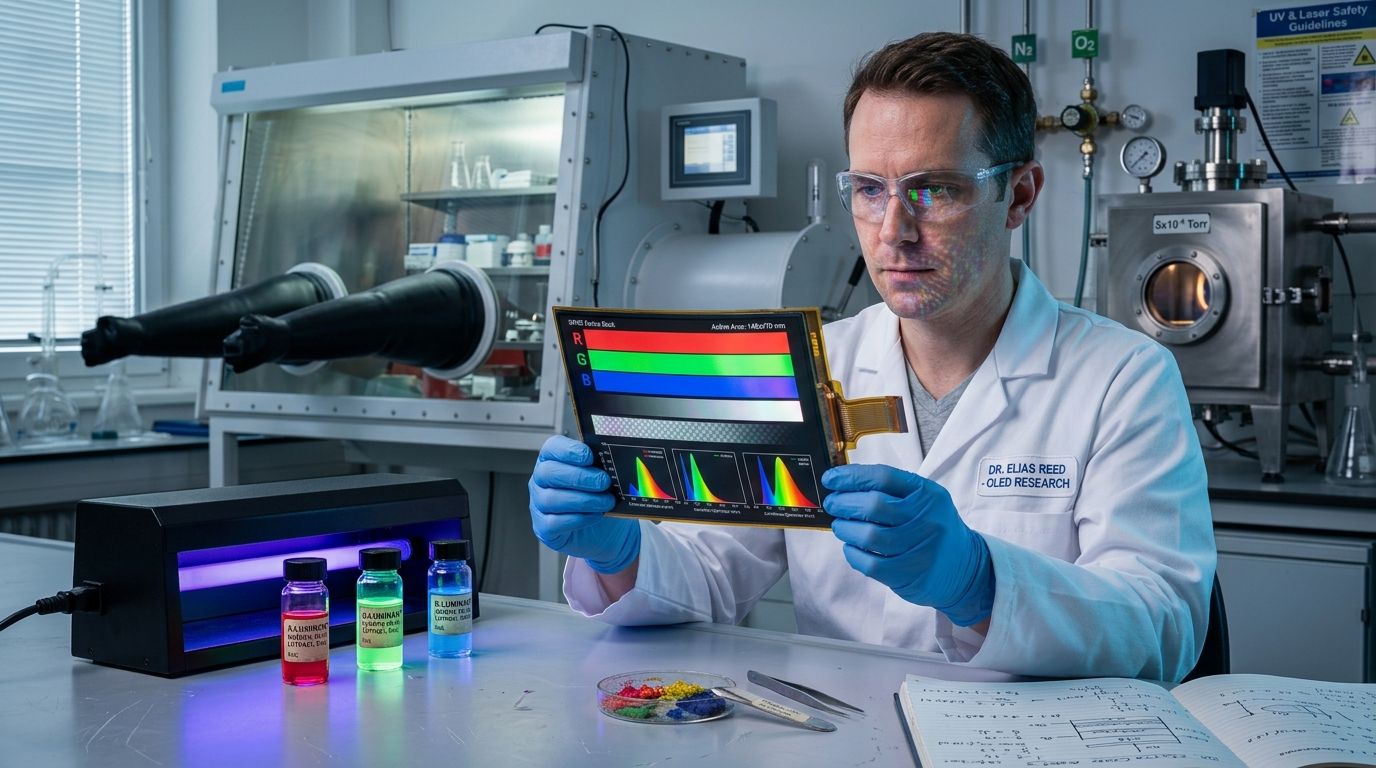
Every time you look at a smartphone, a high-definition television, or a smartwatch screen, you are looking at millions of tiny carbon-based molecules performing a delicate chemical dance. For decades, electronic screens relied on LCD technology, which used a bright white lightbulb behind a thick grid of liquid crystals and color filters to shine light toward your eyes. Today, screen technology relies on Organic Light-Emitting Diodes, or OLEDs. Instead of using a bulky backlight lamp, OLED screens use microscopic organic chemical compounds that emit their own vibrant light whenever a tiny pulse of electricity flows through them, allowing screens to become as paper-thin as a sheet of glass.
How Electric Current Excites Organic Molecules
At the heart of every OLED pixel is a sandwich of ultra-thin chemical layers made from carbon, hydrogen, nitrogen, and heavy metal atoms. When you unlock your phone, the battery pushes electrons into a specialized layer called the electron transport layer, while pulling electrons out of the opposite side to create holes. These electrons and holes travel toward a central emissive layer, where they collide and combine into a short-lived high-energy packet called an exciton. As the exciton drops back down to its resting energy state, it releases its excess energy directly as a clean, bright photon of visible light.
The Metal Catalysts Behind Vibrant Red, Green, and Blue
To build a full-color screen display, chemists must design organic molecules that emit exact wavelengths of red, green, and blue light. Achieving high energy efficiency required introducing heavy metal atoms—most notably iridium and platinum—directly into the organic molecule's core structure, a technique known as phosphorescence. These heavy metal atoms allow the molecule to convert nearly one hundred percent of incoming electrical energy into light, preventing energy from being lost as wasted heat. By altering the specific chemical rings attached to the central metal atom, synthetic chemists tune the exact color of the light emitted down to the nanometer.
Deep Blacks and Flexible Paper-Thin Displays
Because every OLED pixel creates its own light independently, showing the color black is as simple as turning off the electric current for those specific molecules completely. On an old LCD screen, the backlight was always on, leaking light through dark pixels and turning black areas into a muddy dark gray. On an OLED screen, turned-off pixels produce absolute, true pitch black, generating infinite contrast while saving battery power. Furthermore, because these organic chemical layers are only a few hundred nanometers thick, they can be printed directly onto flexible plastic sheets, enabling foldable smartphones and curved displays that were once physically impossible.
The Chemical Craft Behind Modern Electronics
The evolution of display screens reminds us that electronic hardware is fundamentally constrained by chemical material science. By engineering custom organic molecules that translate electrical current directly into pure light, chemists transformed flat screens from heavy glass boxes into flexible, power-efficient windows into the digital world.
True technological magic happens at the molecular level, where custom synthetic chemistry turns electrical current directly into pure, living color.