Molecular Sponges: How Metal-Organic Frameworks Revolutionize Carbon Capture
Team Ilm Ora · 16 October 2026
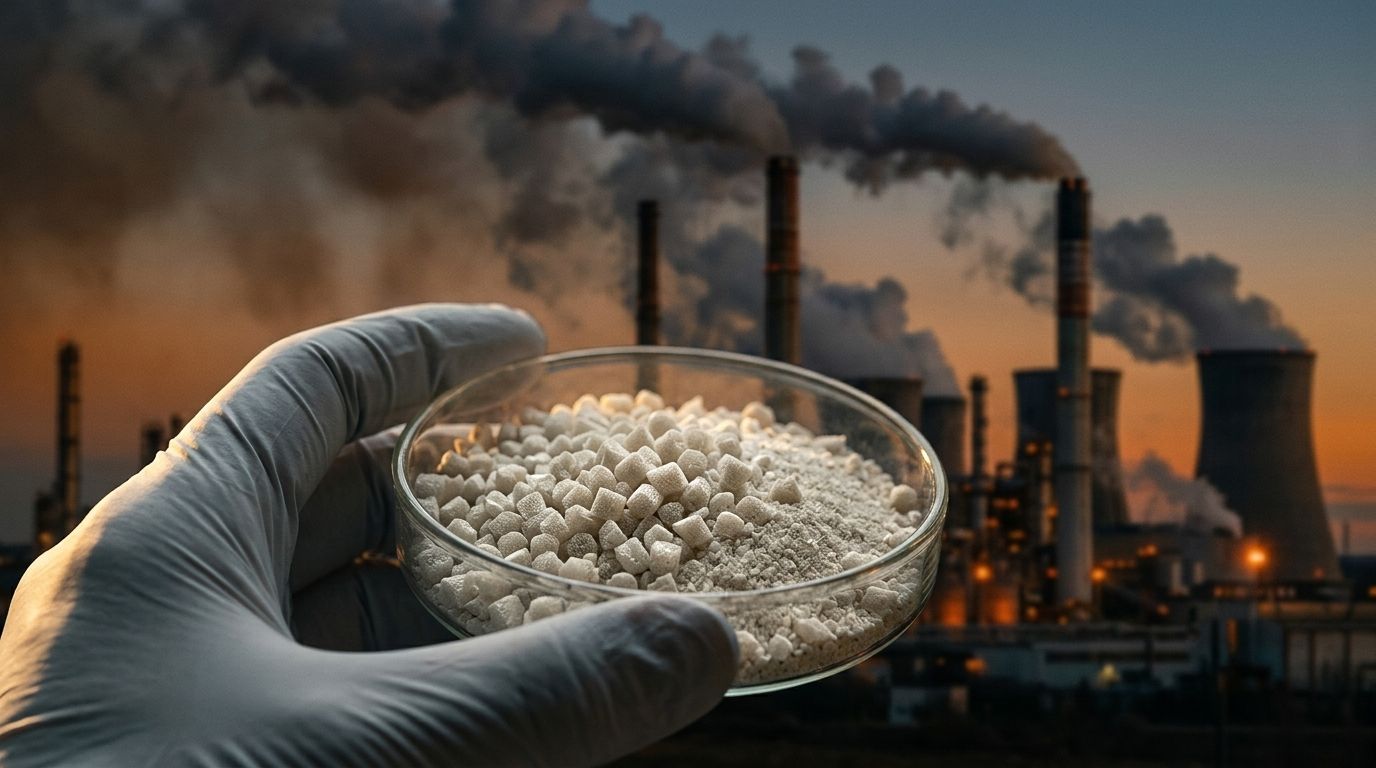
Mitigating global climate change requires capturing millions of tons of carbon dioxide directly from industrial exhaust plumes and open atmospheric air. Traditional industrial carbon capture relies on liquid amine scrubbing, a process that bubbles gas through liquid chemical solvents to absorb carbon dioxide. However, amine scrubbing is energy-intensive, requiring immense heat to strip the trapped gas away so the solvent can be reused. In recent years, materials chemistry has produced a revolutionary solid-state alternative known as Metal-Organic Frameworks, or MOFs. These crystalline materials act as targeted molecular sponges, featuring customizable internal pores that adsorb carbon dioxide with unprecedented efficiency and low energy consumption.
The Architecture of Crystalline Coordination Polymers
To understand how Metal-Organic Frameworks work, one must examine their chemical structure at the nanometer scale. A MOF is a three-dimensional coordination polymer composed of two repeating building blocks: inorganic metal nodes connected by organic ligand struts. The metal nodes consist of metal ions or clusters, such as zinc, copper, iron, or aluminum, while the organic ligands are carbon-based molecules that act as structural bridges. When these components self-assemble through chemical synthesis, they form an open, highly ordered crystalline lattice filled with microscopic pores. The defining feature of MOFs is their extraordinary internal surface area. A single gram of an optimized MOF material can possess an internal surface area exceeding seven thousand square meters, equivalent to the area of an entire football field folded into a microscopic sugar cube. This vast void volume supplies millions of chemical binding sites where gas molecules can assemble.
Adsorption Mechanics versus Chemical Absorption
The primary operational advantage of MOFs lies in the difference between chemical absorption and physical adsorption. In traditional liquid amine absorption, carbon dioxide reacts chemically with the solvent, forming strong covalent bonds. Breaking these chemical bonds to release the stored carbon dioxide requires heating the liquid mixture to over one hundred twenty degrees Celsius, expending massive amounts of thermal energy. In contrast, MOFs capture carbon dioxide primarily through adsorption, where gas molecules adhere to the internal surfaces of the crystalline pores through non-covalent forces, such as van der Waals interactions and electrostatic attractions. Because no permanent covalent bonds are formed, releasing the captured carbon dioxide requires significantly less energy. Chemists can strip the trapped gas from the solid MOF by applying a gentle decrease in pressure or a mild temperature increase, drastically reducing operational costs.
Pore Size Tuning and Open Metal Site Chemistry
A primary challenge in direct carbon capture is selectivity. Flue gas from power plants and ambient atmospheric air are complex mixtures dominated by nitrogen, oxygen, and water vapor, with carbon dioxide present in lower concentrations. MOFs solve this challenge through precise structural tuning. Chemists customize the pore dimensions to match the kinetic diameter of carbon dioxide molecules, physically blocking larger gas molecules from entering the framework. Furthermore, synthetic chemists can engineer open metal sites along the interior pore walls. Open metal sites are unsaturated metal ions within the lattice that possess an exposed positive charge. These positive charges attract the electrical quadrupole moment of carbon dioxide molecules, creating strong, selective physical bonds that pull carbon dioxide out of moving air streams while ignoring non-polar nitrogen and oxygen molecules.
Industrial Deployment and the Future of Direct Air Capture
The real-world scalability of MOFs has advanced rapidly due to breakthroughs in green synthesis techniques. Early MOF manufacturing required expensive, toxic organic solvents and high heating pressures. Modern chemical synthesis utilizes water-based mechanochemical methods, grinding raw metal salts and organic struts together mechanically to mass-produce stable MOF powders at commercial scale. These advanced materials are now deployed in industrial carbon capture units and direct air capture plants worldwide. Pelletized MOF filters capture carbon dioxide directly at power plant outlets, cement factories, and steel mills, preventing greenhouse gases from entering the atmosphere. By supplying a low-energy, highly selective molecular sponge, materials chemistry has transformed carbon capture from a costly industrial burden into a scalable environmental solution.
At the smallest nanometer scale, chemical ingenuity can build vast molecular spaces capable of capturing the gases that threaten our global climate balance.