
When Baghdad, Not Europe, Was the World's Science Capital
Team Ilm Ora · 13 September 2026
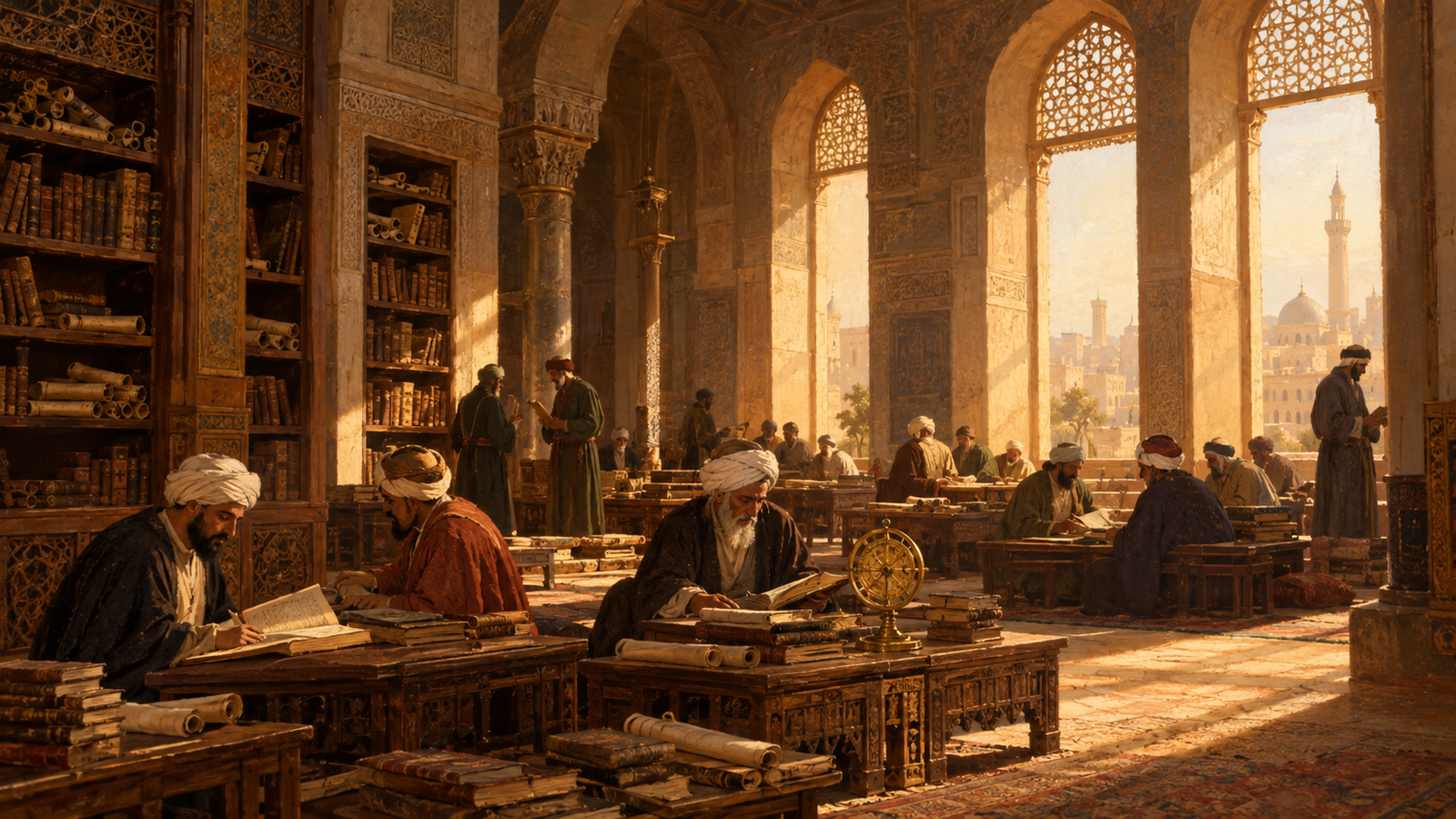
In 8th century Baghdad, at a time when literacy rates in much of Europe were dismal, a library was being built that would eventually hold roughly 400,000 books and produce the word we still use today for algebra.
From a Simple Library to an Intellectual Engine
The House of Wisdom — Bayt al-Hikmah in Arabic — began modestly. Under Caliph al-Mansur (reigned 754–775), who founded Baghdad itself as the new Abbasid capital, a royal book collection called the Khizanat al-Hikmah ("Library of Wisdom") was established, likely inspired by the ancient Museum of Alexandria. Under his grandson, Caliph Harun al-Rashid (reigned 786–809), that collection grew into something larger and more active.
The real transformation came under al-Rashid's son, Caliph al-Ma'mun, who ruled from 813 to 833. Al-Ma'mun personally attended academic debates hosted at the House of Wisdom and expanded it dramatically — adding a full translation department, an astronomical observatory, medical consultation rooms, and accommodations for visiting scholars from across the known world. Under his patronage, the House of Wisdom grew into something closer to a research university than a library: a public academy where astronomy, medicine, mathematics, philosophy, and engineering were actively studied, debated, and expanded, not just archived.
The Translation Movement That Saved Ancient Knowledge
The House of Wisdom's most historically consequential project was what's now called the Translation Movement — a sustained, organized effort to translate scientific and philosophical texts from Greek, Persian, Indian, and Syriac sources into Arabic. This wasn't casual scholarship; it involved dedicated translators, funded positions, and what amounted to a coordinated national research effort centuries before anything comparable existed in Europe.
This mattered enormously for a reason people rarely appreciate: many classical Greek scientific and philosophical texts survive today only because they were translated into Arabic during this period, at a time when the originals were being lost, destroyed, or simply neglected elsewhere. When these works eventually made their way back into Europe centuries later — partly through Islamic Spain — they arrived not as fragile Greek originals, but as Arabic translations that had already been studied, annotated, and in many cases substantially improved upon.
Where "Algebra" Actually Comes From
Among the scholars associated with the House of Wisdom was a Persian mathematician and astronomer named al-Khwarizmi, who studied and worked there under al-Ma'mun. Al-Khwarizmi wrote a mathematical text called Al-Kitab al-Mukhtasar fi Hisab al-Jabr wa'l-Muqabala — "The Compendious Book on Calculation by Completion and Balancing." The word al-jabr in that title, referring to a specific method of solving equations, is the direct root of the modern English word "algebra."
Al-Khwarizmi also played a central role in introducing what are now called Hindu-Arabic numerals — including the concept of zero as a number — into the Islamic scholarly tradition, work that later spread into Europe and replaced Roman numerals. His name itself, transliterated into Latin as "Algoritmi," is the direct linguistic root of the modern word "algorithm." Other House of Wisdom scholars include al-Kindi, known as "the philosopher of the Arabs," who did foundational work on optics and the mechanics of vision, and Hunayn ibn Ishaq, considered one of history's greatest translators, responsible for rendering huge volumes of Greek medical and philosophical work into Arabic.
An Institution the Size of a Small City's Knowledge
By some estimates, the House of Wisdom's collection eventually held around 400,000 books — an almost unthinkable number for the era, covering mathematics, astronomy, geology, medicine, and philosophy. Beyond translation and preservation, the House of Wisdom hosted original research: scholars there worked on problems including calculating the circumference of the Earth using astronomical measurement, centuries before this kind of empirical geodesy became common practice elsewhere.
The End: 1258
The House of Wisdom's story ends abruptly and violently. In 1258, the Mongol army under Hulagu Khan besieged and sacked Baghdad. According to historical accounts, so many books from the House of Wisdom and the city's other libraries were thrown into the Tigris River that its waters reportedly ran black with ink for days. Whatever the precise scale of the destruction — accounts from the period vary and some details have likely been exaggerated over centuries of retelling — the House of Wisdom itself, and the concentrated, centuries-long intellectual project it represented, effectively ended with the fall of Baghdad.
Why This Deserves a Place in the Story of Science
The common narrative of scientific progress often skips directly from ancient Greece to the European Renaissance, as if nothing much happened in the roughly thousand years in between. The House of Wisdom is direct evidence that this isn't accurate. For close to two centuries, Baghdad functioned as one of the world's genuine centers of scientific research, translation, and original mathematical work — producing tools, vocabulary, and preserved knowledge that later became foundational to the European scientific tradition that gets far more attention today.
The word "algebra" and the word "algorithm" both trace back to scholars working in a single library in 9th-century Baghdad — proof that the story of modern mathematics runs directly through a city, and a century, most science textbooks quietly skip over.