
The Woman Who Founded the World's Oldest University
Team Ilm Ora · 13 September 2026
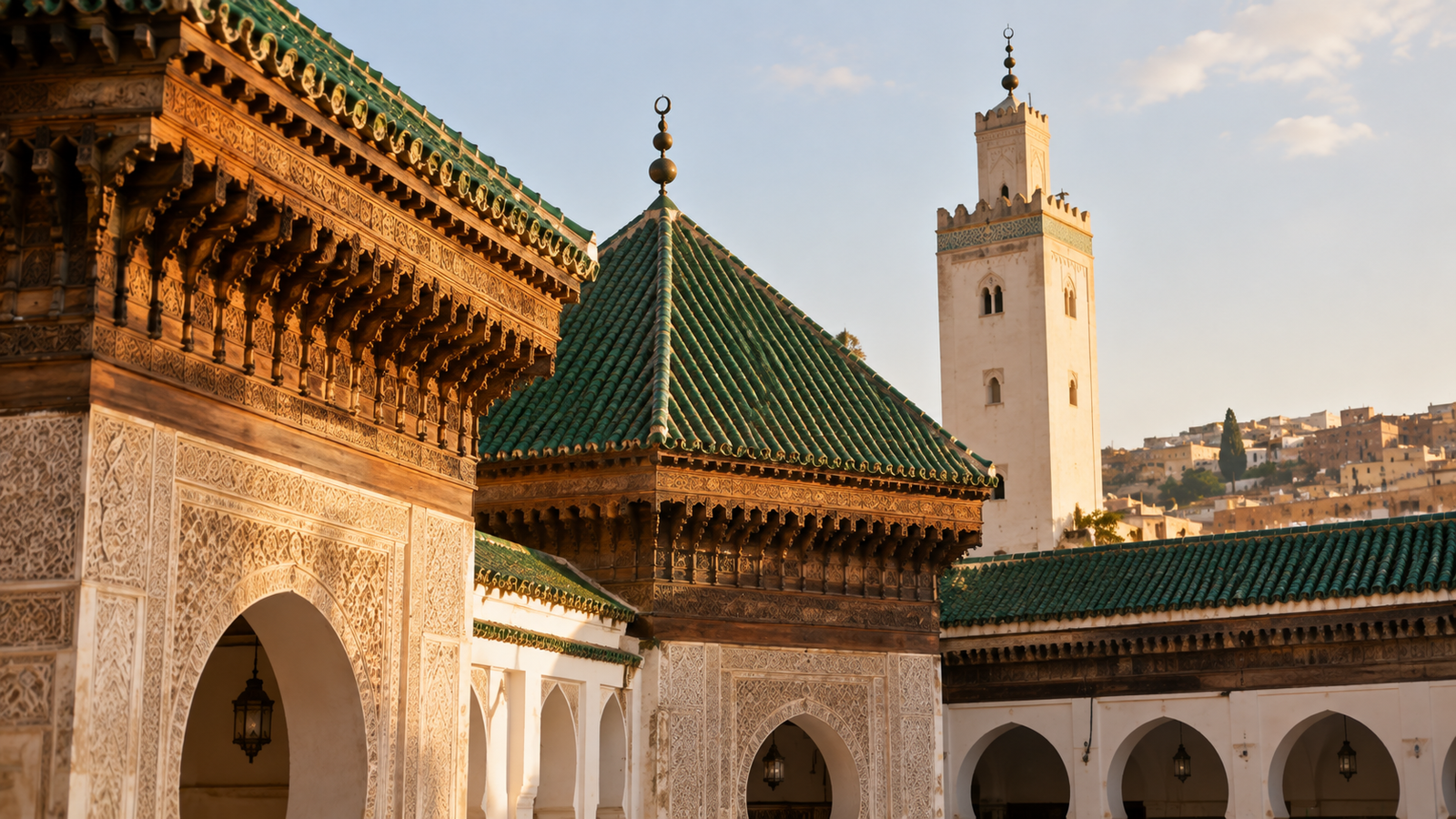
Long before Oxford, before Bologna, before any European institution most people associate with "the first university," a woman used her father's fortune to build one — in a city in Morocco, in the year 859.
A Refugee Family's Fortune
Fatima al-Fihri was born around 800 CE in Qayrawan, a city in what's now Tunisia. Sometime in the early 9th century, political instability pushed her family to migrate west to Fez, Morocco — then a growing, cosmopolitan hub of trade and scholarship under the Idrisid dynasty, the first Islamic state established in that region. Fatima's father, a successful merchant, died along with her husband and brother in a short span of time, leaving Fatima and her sister Mariam a substantial inheritance and, unusually for the era, genuine financial independence.
Rather than simply live off that wealth, both sisters chose to spend it on their community. Mariam funded the construction of the Andalusian Mosque in Fez, built for refugees who had fled political unrest in Islamic Spain. Fatima, a devout and educated woman well versed in Islamic jurisprudence and religious tradition, committed her entire fortune to a different project: a mosque for Fez's community of migrants from her home city of Qayrawan.
From a Modest Mosque to a Center of Learning
Construction finished in 859 CE. The original building was modest by later standards — roughly 30 meters long, with a simple prayer hall, four aisles, a rear minaret, and a courtyard. Fatima named it Jami' al-Qarawiyyin, after Qayrawan, the city her family had fled.
What made this mosque different from countless others built in the same era was what it became. Rather than functioning purely as a place of worship, al-Qarawiyyin developed a formal system of religious and scholarly instruction, gradually expanding its curriculum well beyond theology to include grammar, logic, medicine, astronomy, and mathematics. By the 13th and 14th centuries, at the height of its influence, it hosted so many students that surrounding neighborhoods had to build dozens of additional religious schools just to house them, and its library held more than 30,000 volumes gathered from across the Islamic world and beyond.
The First Real "Degree"
Al-Qarawiyyin's most historically significant contribution may be structural rather than architectural: the way it formalized the process of certifying knowledge. Students who studied consistently under the institution for around five years and demonstrated mastery of a subject were awarded an ijazah — a formal license certifying their competence in that specific field. This system, requiring sustained study and a demonstrated standard of mastery before certification, is widely considered a direct forerunner of the modern academic degree.
That's the basis for the specific historical claim now attached to al-Qarawiyyin: it's recognized by UNESCO and listed in the Guinness Book of World Records as the oldest existing, continuously operating educational institution in the world that grants degrees — predating, by roughly a century, the founding of Egypt's Al-Azhar (another major early Islamic center of learning) and by more than two centuries the earliest universities to appear in medieval Europe.
A Living Institution, Not a Ruin
Unlike most sites this old, al-Qarawiyyin isn't a preserved historical monument people simply visit and photograph. It has functioned continuously since 859 CE. In 1963, it was formally absorbed into Morocco's modern state university system and renamed the University of Al Quaraouiyine two years later, bridging more than a millennium of uninterrupted operation with a fully modern academic structure. Its historic library, restored in a major renovation completed in 2016, still holds rare manuscripts, including a 9th-century Quran on gazelle parchment and volumes tied to the historian Ibn Khaldun.
Why Fatima al-Fihri's Story Rarely Gets Told
Ask most people, anywhere in the world, who founded the first university, and it's unlikely "a Muslim woman in 9th-century Morocco" comes to mind. That gap says more about which histories get told than about which histories are true. Fatima al-Fihri wasn't a queen, a ruler, or a religious authority — she was a private individual who inherited money and made a specific, deliberate choice about what to build with it. More than a thousand years later, that choice is still standing, and it's still teaching students.
Nearly two centuries before Oxford held its first classes, a woman in Fez had already built the institution now recognized as the world's oldest degree-granting university — using an inheritance she chose to spend on something that would outlast her by more than a millennium.