
There Is No Such Thing as "Right Now"
Team Ilm Ora · 12 September 2026
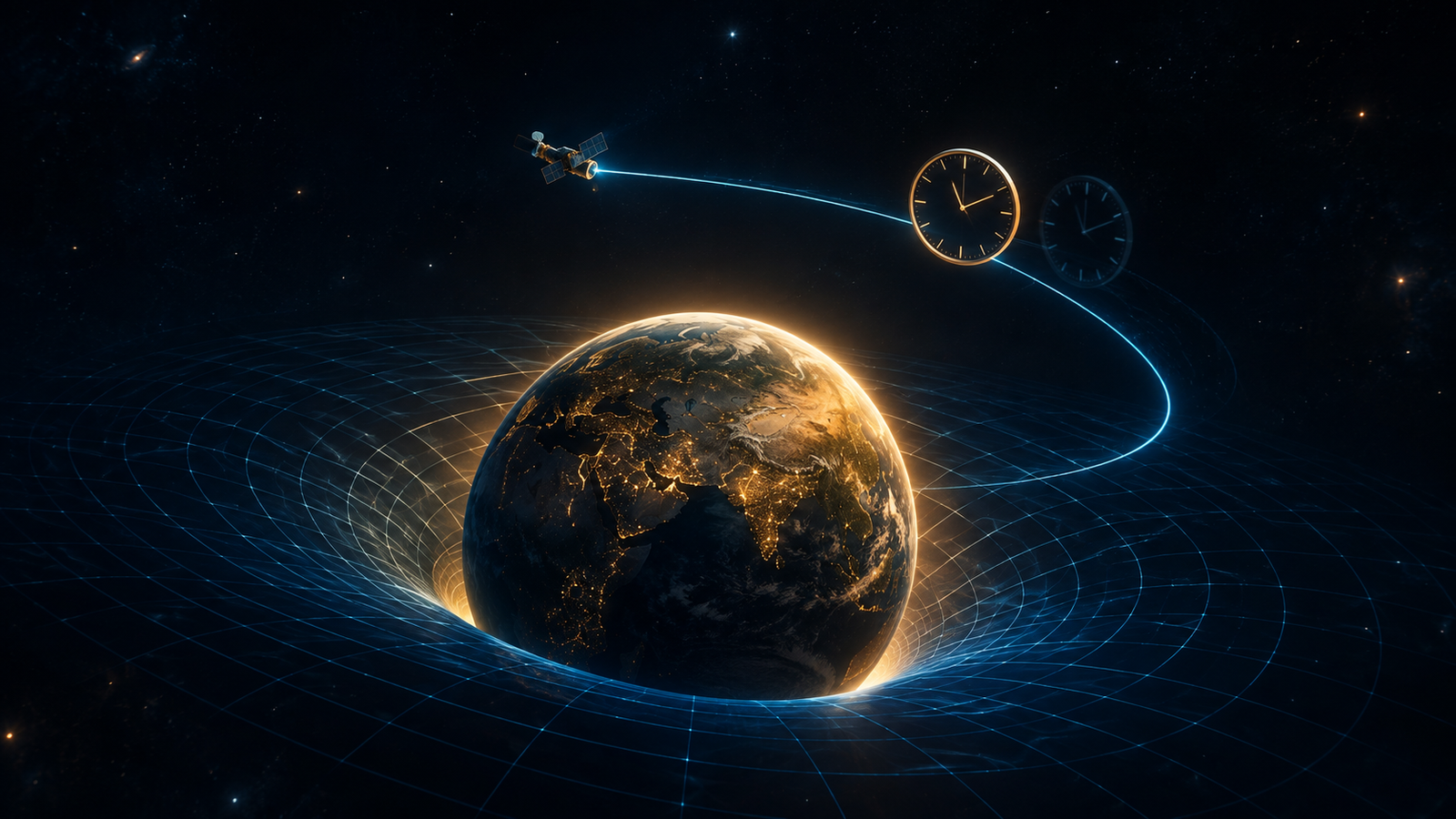
You've never shared a single moment with anyone else in your life — not really. Two people standing in the same room, moving at slightly different speeds, are aging at very slightly different rates, and neither one is wrong about what time it is where they stand.
The Assumption Physics Quietly Destroyed
Everyone assumes the same thing without ever really questioning it: that "now" is one single moment, happening everywhere at once, the same for you, your neighbor, someone in Tokyo, and an astronaut floating above the planet. It's such a basic part of how we experience life that it doesn't even feel like an assumption. It feels like a plain fact.
It isn't true. And this isn't a philosophical trick or a "what if" thought experiment — it's something physics has actually measured, tested, and confirmed, over and over, for more than a century. Time doesn't move at one universal speed for everyone. It moves at a personal rate for each individual object, and that rate depends on two things: how fast you're moving, and how strong the gravity is around you. Two people moving differently relative to each other can each correctly say the other person's clock is running slow — and there's no referee clock hiding somewhere in the universe that can step in and settle who's "really" right. No such master clock exists.
Stick with this for a minute, because the payoff is worth it: this same effect is the reason your phone can tell you where you are.
Two Invisible Forces Fighting Inside Every Moving Clock
There are two separate effects at play here, and they come from two different parts of Einstein's work.
Effect one: speed slows your clock down. This comes from Einstein's 1905 theory (special relativity). The faster something moves relative to you, the slower its clock ticks compared to yours. Physicists describe exactly how much slower using a simple ratio called the Lorentz factor:
γ = 1 / √(1 − v²/c²)
Don't worry about solving this — just know what it's saying: v is how fast something is moving, and c is the speed of light (a fixed number, roughly 300,000 kilometers per second). The faster something goes compared to light speed, the bigger this number gets, and the more its clock slows down compared to yours. At normal speeds — a car, a plane, even a rocket — this number is so close to 1 that you'd never notice it in daily life. But it's never exactly 1. It's always there, quietly working, even if the effect is too tiny to feel.
Effect two: gravity speeds your clock up. This comes from Einstein's 1915 theory (general relativity). A clock sitting somewhere with weaker gravity — say, further from Earth's surface — ticks faster than a clock sitting somewhere with stronger gravity. The rough rule, for gravity as weak as Earth's, looks like this:
Δt/t ≈ ΔΦ/c²
In plain terms: the difference in how fast two clocks tick is proportional to the difference in gravitational "strength" between where they're sitting. Higher up, weaker gravity, faster ticking.
Here's the part that makes this genuinely strange: these two effects don't just add up neatly. Depending on the situation, they can pull in opposite directions, and one can partly or fully cancel the other out.
How This Fixes Your GPS, Right Now
Every GPS satellite orbits about 20,200 kilometers above you, moving at roughly 14,000 km/h. Put both effects together for a satellite at that speed and that height, and here's what happens:
Because of its speed, the satellite's clock runs slower than a clock on the ground — losing about 7 microseconds every day. Because of its weaker gravity up there, the satellite's clock runs faster than a clock on the ground — gaining about 45 microseconds every day.
Net result: left alone, a GPS satellite's clock would drift about 38 microseconds ahead of a clock on Earth's surface, every single day. That might sound too small to matter — a microsecond is one-millionth of a second — but because GPS calculates your position using the speed of light and tiny timing differences, a drift like that would make your location on the map wander by about 10 kilometers a day. "Turn left in 300 feet" would slowly turn into "you're somewhere in the next town."
So GPS engineers don't ignore this. They build the correction directly into the satellite before it's ever launched, adjusting its onboard clock so it stays in sync with clocks on the ground. Every single time your phone finds your location, it's quietly relying on Einstein's equations having been done correctly, decades ago, by people who never got to see a smartphone.
Proof by Airplane: Flying Atomic Clocks Around the World
You don't need to trust this on faith — it's been tested directly, more than once.
In October 1971, two researchers named Joseph Hafele and Richard Keating carried four extremely precise atomic clocks onto commercial airplanes and flew them around the entire planet — once heading east, once heading west — then compared them to a reference clock that stayed put at the U.S. Naval Observatory.
Before the flights even happened, relativity made an exact prediction of what should occur: the eastward clocks (moving in the same direction Earth already spins) should lose about 40 nanoseconds compared to the ground clock; the westward clocks (moving against Earth's spin, so effectively moving slower through space) should gain about 275 nanoseconds.
When the clocks landed and were compared, the actual results were: the eastward clocks lost 59 nanoseconds, and the westward clocks gained 273 nanoseconds — remarkably close to what the theory predicted, using nothing more exotic than commercial airline flights and very good clocks.
Proof by Tower: Gravity Bending Light in a Harvard Stairwell
Nine years before that, in 1959, two physicists named Robert Pound and Glen Rebka tested the gravity half of this story using a 22.5-meter tower at Harvard — about the height of a seven-story building.
They placed a radioactive source that emits gamma rays (a type of high-energy light) at the top of the tower, and a detector at the bottom. Einstein's theory predicted that as those gamma rays fell down through Earth's gravity, they'd gain a very slight — almost immeasurably small — boost in frequency, changing their "color" by a specific tiny fraction. Using a clever technique called the Mössbauer effect, which lets you measure incredibly small changes in light frequency, Pound and Rebka measured that shift directly: theory predicted a change of about 2.46 parts in a quadrillion; they measured 2.56 parts in a quadrillion. That's a match within about 10%, confirmed using a stairwell.
Seventeen years later, in 1976, a follow-up experiment called Gravity Probe A repeated the same basic test using a much bigger "tower" — a rocket carrying an extremely precise atomic clock 10,273 kilometers into space. It confirmed the same prediction to within 70 parts per million, making it one of the most precise tests of general relativity ever performed at the time.
A Real Person Who Came Home Slightly Younger
Here's the version of this story that involves an actual human being, not just a clock.
Between 2015 and 2016, astronaut Scott Kelly spent 340 days straight aboard the International Space Station, while his identical twin brother, Mark, stayed on Earth. When Scott landed, NASA calculated that he had aged roughly 5 milliseconds less than his brother during that time.
Here's why: the ISS orbits much lower than GPS satellites — about 400 km up, instead of 20,200 km — so the "weaker gravity speeds you up" effect barely matters there. But the ISS moves very fast, roughly 28,000 km/h, so the "speed slows you down" effect wins out overall. The result: two people, born minutes apart, sharing identical DNA, ended up very slightly out of sync in age, for no reason other than one of them moved through space differently than the other.
Five milliseconds is far too small to notice or feel. But it's not made up, not a rounding error, and not a metaphor. It's a small, real, measured fact about two specific human bodies.
Why This Happens: Space and Time Are the Same Fabric
Here's the deepest reason behind everything above, explained as simply as possible.
Einstein's big insight was that space (the three directions you can move in — left-right, up-down, forward-back) and time aren't two separate, unrelated things. They're stitched together into one combined structure called spacetime. Every object — you, a satellite, a beam of light — is always moving through this combined structure at one fixed total "speed." Physicists describe this using something called the spacetime interval:
ds² = −c²dt² + dx² + dy² + dz²
You don't need to do the math to get the idea behind it: think of it like a fixed budget. If you spend more of that budget moving through space (going faster), you have less left over to spend moving through time — so your clock ticks slower relative to someone who stayed still. That's the deep reason speed causes time dilation. Gravity works by literally bending this same spacetime fabric — mass curves it, the way a heavy ball placed on a stretched sheet curves the sheet around it — and a clock sitting in a more curved part of that fabric ticks at a different rate than a clock sitting somewhere flatter.
None of this is abstract math trapped in a textbook. It's confirmed by airplanes, a stairwell in Massachusetts, a rocket, a set of twins, and the phone currently in your pocket.
There is no cosmic master clock keeping the same beat for everyone. Every observer, moving at their own speed, standing at their own height, carries their own slightly different version of "now" — and the universe has never once stepped in to say which version is the real one.