Empty Space Might Not Be Empty, Or Smooth
Team Ilm Ora · 12 September 2026
Zoom into a photo on your phone far enough and the smooth image breaks apart into little colored squares — it was never actually smooth, it just looked that way from a distance. A group of physicists has spent thirty years building the case that empty space works exactly the same way.
Two Rulebooks That Don't Agree
Physics runs on two separate sets of rules, and here's the uncomfortable part: they don't actually agree with each other.
The first rulebook is general relativity, Einstein's 1915 theory of gravity. It describes gravity as a kind of bending or curving of space and time itself, caused by anything with mass — a planet, a star, you. It works beautifully for big, smooth things: planets orbiting stars, light bending around galaxies.
The second rulebook is quantum mechanics, built up through the 1920s. It describes how the tiniest things in the universe — atoms, electrons, particles of light — actually behave. It also works beautifully, but only for very small, "grainy" things.
Here's the problem: whenever physicists try to combine these two rulebooks — to describe gravity using the same quantum rules that work for particles — the math breaks. It spits out impossible answers, like infinities where there should be normal numbers. This isn't a small technical hiccup. It means physics genuinely doesn't have a working explanation for the two places in the universe where both rulebooks should apply at once: the inside of a black hole, and the very first sliver of a second after the Big Bang.
Loop Quantum Gravity (LQG) is one of two major attempts to fix this (the other being string theory). Instead of adding new particles or extra dimensions, it asks a much stranger question: what if space itself — the "stage" everything happens on — needs to be broken down into tiny pieces, the same way matter turned out to be made of atoms instead of being infinitely smooth and divisible?
Rewriting Gravity's Math So It Can Be Quantized
In 1986, a physicist named Abhay Ashtekar rewrote the equations of general relativity using a different set of mathematical tools — now called Ashtekar variables. Think of it like translating a recipe from one language into another that happens to use ingredients you already know how to combine. His version described gravity using variables that looked much more like the ones already used successfully for the other basic forces of nature (electromagnetism, for example).
That translation mattered because it let physicists apply a specific quantum trick that already worked well elsewhere: instead of describing a field point by point, you describe what happens when you trace a small closed loop through it — called a holonomy. This is literally where the theory gets its name: "loop" quantum gravity.
Spin Networks: Space Made of Knots
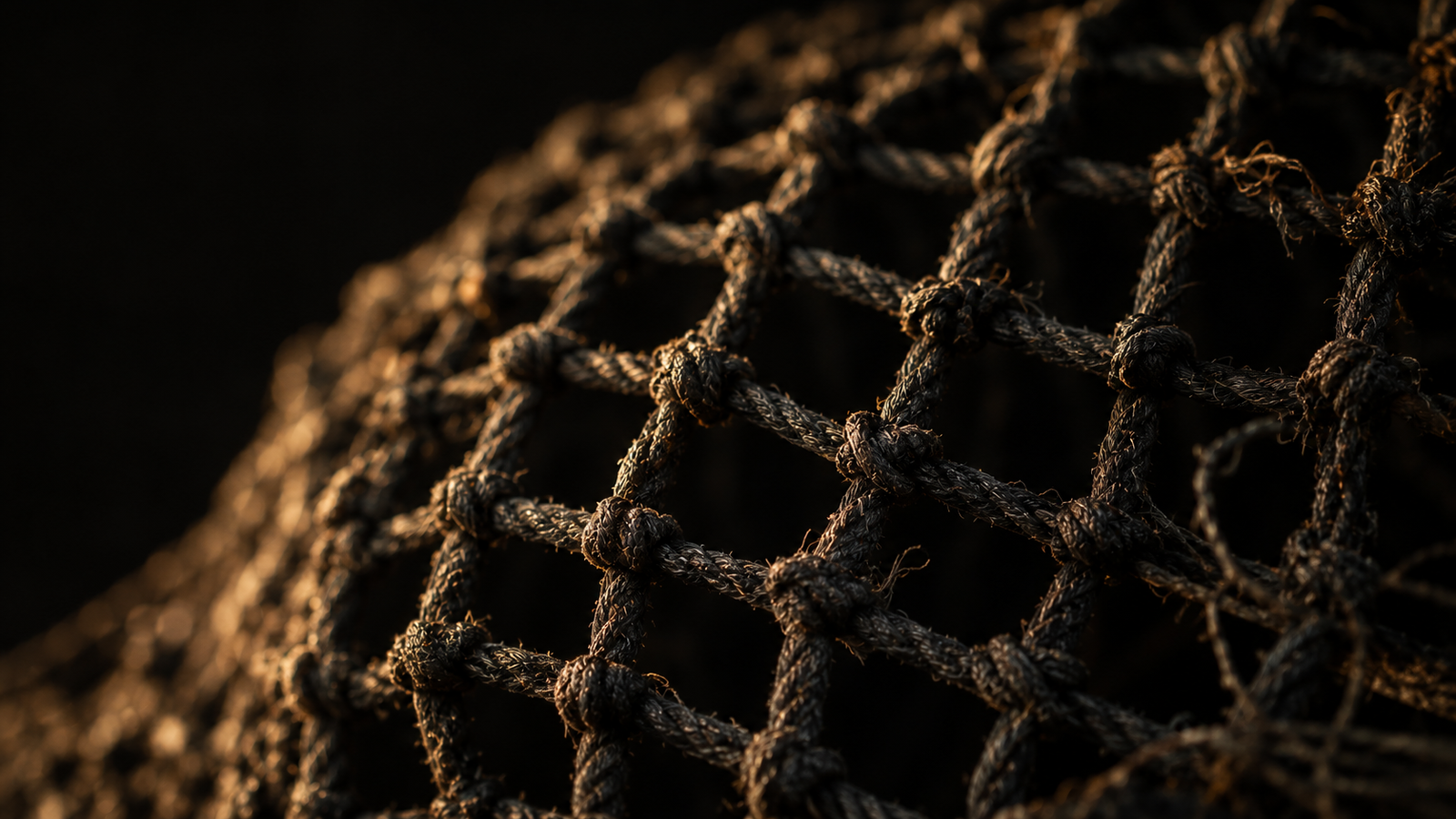
Building on Ashtekar's work, physicists Carlo Rovelli and Lee Smolin introduced the theory's central idea in 1995: the spin network, based on an older mathematical concept from physicist Roger Penrose. Picture a web of connected lines and knots — like a fishing net, but where every strand and knot carries a specific number attached to it (a "spin" value, which can be 0, ½, 1, 1½, 2, and so on — the same kind of number used to describe how particles spin).
Here's the part that's genuinely mind-bending: this web isn't a diagram of space. In this theory, it is space. There's no empty stage first, with the net laid over top. The net — the pattern of knots and connections — is the only thing that exists; space is just what we call the pattern itself. As this web changes and shifts over time, it traces out something called a spin foam — essentially, spacetime unfolding step by step through discrete little jumps, rather than flowing smoothly like a river.
Space Has a Smallest Possible Size
Here's the theory's boldest claim: according to the math, area and volume aren't infinitely divisible. There's a smallest possible chunk of area that can exist, and you cannot have anything smaller than it — the same way you can't have half a photon (a particle of light) of a given energy.
Physicists calculate this smallest chunk using a formula. You don't need to solve it — just know what it's telling you:
a(j) = 8π γ l_P² √(j(j+1))
Here, j is that spin number from the web of knots described above, l_P is the Planck length — an almost unimaginably small distance, about 0.000000000000000000000000000000000016 meters — and γ (the Greek letter gamma) is a fixed number specific to this theory, called the Barbero-Immirzi parameter. Every time a strand of the spin-network web punches through a surface, it adds one of these fixed little chunks of area. Add up all the chunks, and you get the total area — but you can never get anything smaller than one chunk. Space, in other words, may have a texture, the way sand looks smooth from far away but is actually made of countless separate grains up close.
Checking the Math Against Black Holes
That gamma number above isn't fixed by the theory on its own — physicists needed an outside way to pin it down, and they found one using black holes.
Back in 1974, Stephen Hawking and Jacob Bekenstein showed that black holes carry a kind of "information content," or entropy, that depends only on the size of the black hole's surface (its event horizon). Loop Quantum Gravity offers its own, completely separate way to calculate that same number, by counting how many different possible spin-network configurations could produce a black hole horizon of a given size — similar to counting how many different arrangements of grains of sand could make up a sandcastle of a certain size.
When physicists ran this calculation and compared it to Hawking and Bekenstein's older result, the two independent answers matched — but only if that gamma number was set to approximately 0.2375 (some calculation methods put it closer to 0.274). Two completely different ways of counting, arriving at the same number, is a strong hint that the underlying idea is onto something real, even without a lab experiment to directly test it.
Rewriting the Beginning of Time: The Big Bounce
One of the most dramatic uses of this theory involves the very beginning of the universe. Standard general relativity, if you rewind the universe's expansion all the way back, predicts a singularity — a single point of infinitely squeezed, infinitely dense matter, where the equations simply stop making sense. That point is what we usually call the Big Bang.
Starting in 2006, physicists Abhay Ashtekar, Tomasz Pawlowski, and Parampreet Singh applied Loop Quantum Gravity's math to a simplified model of the whole universe (called Loop Quantum Cosmology) and found something remarkable: the infinite-density singularity disappears. Instead, as density climbs to an extreme value — about 41% of the maximum possible "Planck density" — the same graininess that gives space a smallest possible size also creates an effective repulsive push, strong enough to stop the collapse and bounce it back outward. In this picture, the Big Bang wasn't really a beginning from nothing — it was a Big Bounce, a rebound from a previous contracting universe, with math that stays perfectly well-defined the whole way through, unlike older attempts, which broke down at exactly this point.
The Honest Catch
Here's the part that keeps this from being an accepted, settled fact rather than a serious ongoing theory: the smallest chunks of space this theory predicts are so incredibly tiny — 20 orders of magnitude smaller than anything any particle accelerator built or even planned could ever directly detect — that nobody has been able to test this prediction in a lab. That's exactly why Loop Quantum Gravity remains one of two leading competing ideas, alongside string theory, rather than a proven fact.
What makes it worth taking seriously anyway isn't a lab result. It's that the math holds together internally: a solid rewriting of Einstein's gravity, a clear way to make it quantum, a prediction about black holes that independently lines up with an older, separately-derived result, and a fix for the Big Bang's biggest mathematical headache — all falling out of the same basic starting assumptions, rather than being patched on separately.
If this theory — or its biggest rival — turns out to be right, the empty space between you and the nearest star was never actually empty or smooth. It's woven, grain by grain, at a scale about a hundred billion billion times smaller than a proton — and the smooth universe you see around you is simply what that weave looks like from very, very far away.