Thinking Before Speaking: Test-Time Compute Scaling in Artificial Intelligence
Team Ilm Ora · 18 October 2026
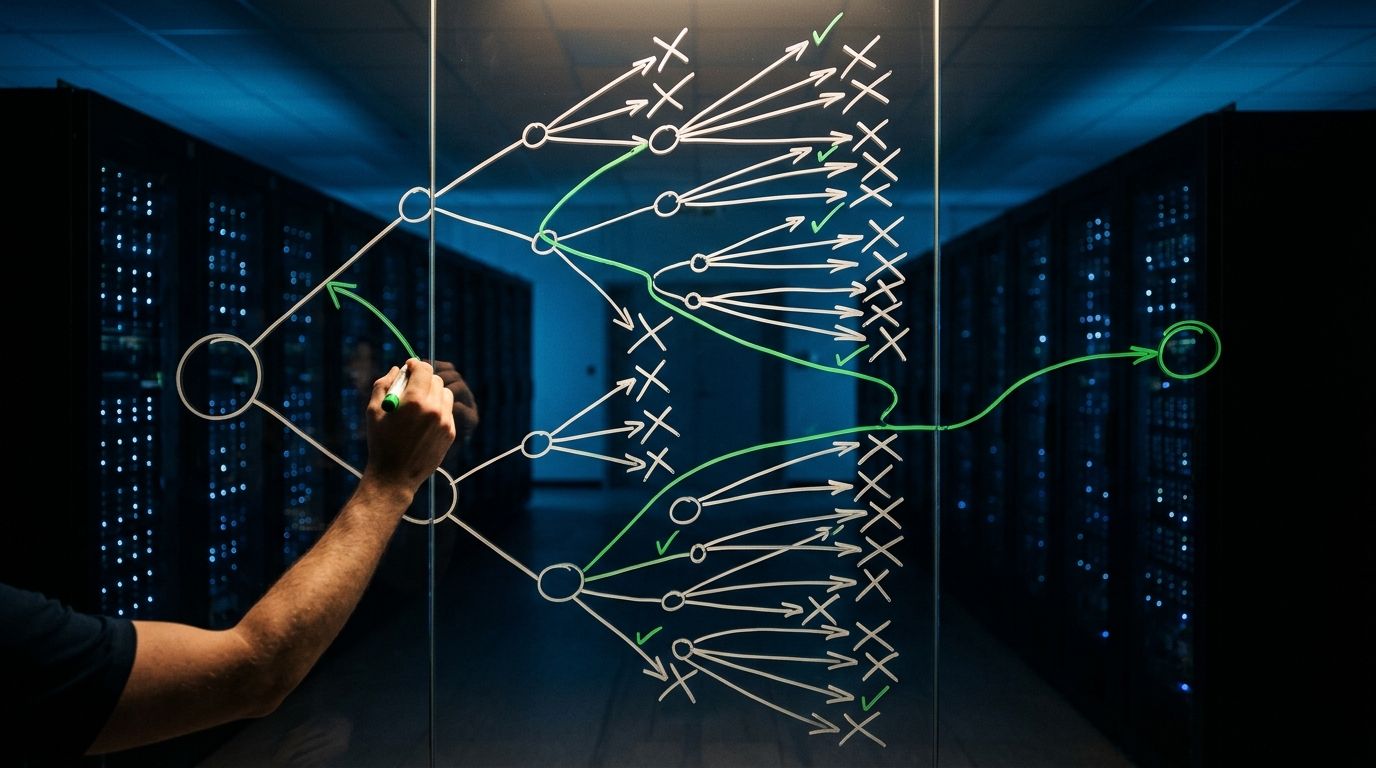
For years, the development of large language models followed a single scaling paradigm: train bigger neural networks on larger datasets using massive GPU supercomputers. While this approach produced models capable of generating fluent text and answering broad factual questions, these systems frequently struggled with complex logic, multi-step mathematics, and advanced scientific reasoning. When presented with a challenging riddle or mathematical proof, early models generated answers instantaneously token by token without evaluating whether their initial logic was correct. The emerging frontier in artificial intelligence shifts focus toward test-time compute scaling, allocating additional computational power during the inference phase to allow models to explore, evaluate, and self-correct multiple reasoning branches before generating a final answer.
The Dual Systems of Machine Cognition
To understand test-time compute, one can draw a parallel to human cognitive psychology, specifically Daniel Kahneman's framework of System 1 and System 2 thinking. System 1 represents fast, instinctive, automatic thought, such as the mental process used to read a billboard or answer two plus two. Traditional language models operate almost entirely as System 1 engines, predicting the most statistically probable next word based on patterns learned during pre-training. System 2 represents slow, deliberate, analytical thought, such as the mental effort required to solve a complex chess puzzle or write a mathematical proof. System 2 thinking requires generating trial hypotheses, evaluating intermediate logical steps, recognizing errors, and backtracking when a strategy fails. Test-time compute scaling supplies neural networks with a digital equivalent of System 2 thinking, converting instantaneous output generation into an active, deliberate search process.
Search Trees and Process Reward Models
The primary algorithmic mechanism driving test-time compute scaling is tree search, specifically variations of Monte Carlo Tree Search. When presented with a complex problem, the AI model does not generate a direct answer immediately. Instead, it treats the prompt as the root node of an expanding decision tree. The model generates multiple alternative reasoning paths in parallel, producing candidate intermediate steps. A specialized neural network, called a process reward model, evaluates each intermediate logical step individually, assigning a quality score to every reasoning branch. If a branch score drops due to a mathematical mistake or logical contradiction, the search algorithm abandons that path and backtracks to explore alternative branches, spending computational power where the likelihood of finding a correct solution is highest.
The Economics of Search Compute versus Pre-Training
Test-time scaling alters the economics and performance scaling laws of artificial intelligence. Historically, achieving higher accuracy on complex benchmarks required building models with trillions of parameters, costing tens of millions of dollars in pre-training hardware. Test-time compute demonstrates that a smaller, well-trained base model can outperform a model ten times its size on complex reasoning tasks if it is allowed to compute for several seconds or minutes during inference. By balancing pre-training compute against inference search compute, developers optimize resources. Simple queries, such as summarizing an email, use minimal test-time compute, delivering instant answers. Complex queries, such as diagnosing a rare software bug or verifying an engineering calculation, trigger extensive test-time compute search, running thousands of internal reasoning rollouts to guarantee logical accuracy.
Self-Correction and the Path to Verifiable Reasoning
A major breakthrough enabled by test-time scaling is automated self-correction. In traditional neural networks, an error made in the second step of a ten-step mathematical proof cascades through the rest of the generation, guaranteeing a wrong final answer. Under a test-time compute framework, the model uses automated verification tools, such as formal code execution environments or symbolic logic checkers, to test its own intermediate outputs. If an intermediate code snippet throws an execution error, the process reward model registers the failure, forces the model to generate a corrective patch, and verifies the fix before proceeding to the next step. This self-correcting loop dramatically reduces hallucinations and logical errors, transforming AI from a passive pattern matcher into a reliable, analytical reasoning assistant for science and engineering.
True intelligence is measured not by how quickly a system speaks, but by its capacity to pause, ponder, and correct its own mistakes.