The Genesis of Automation: Hydraulic Engineering in the Medieval Islamic World
Team Ilm Ora · 12 October 2026
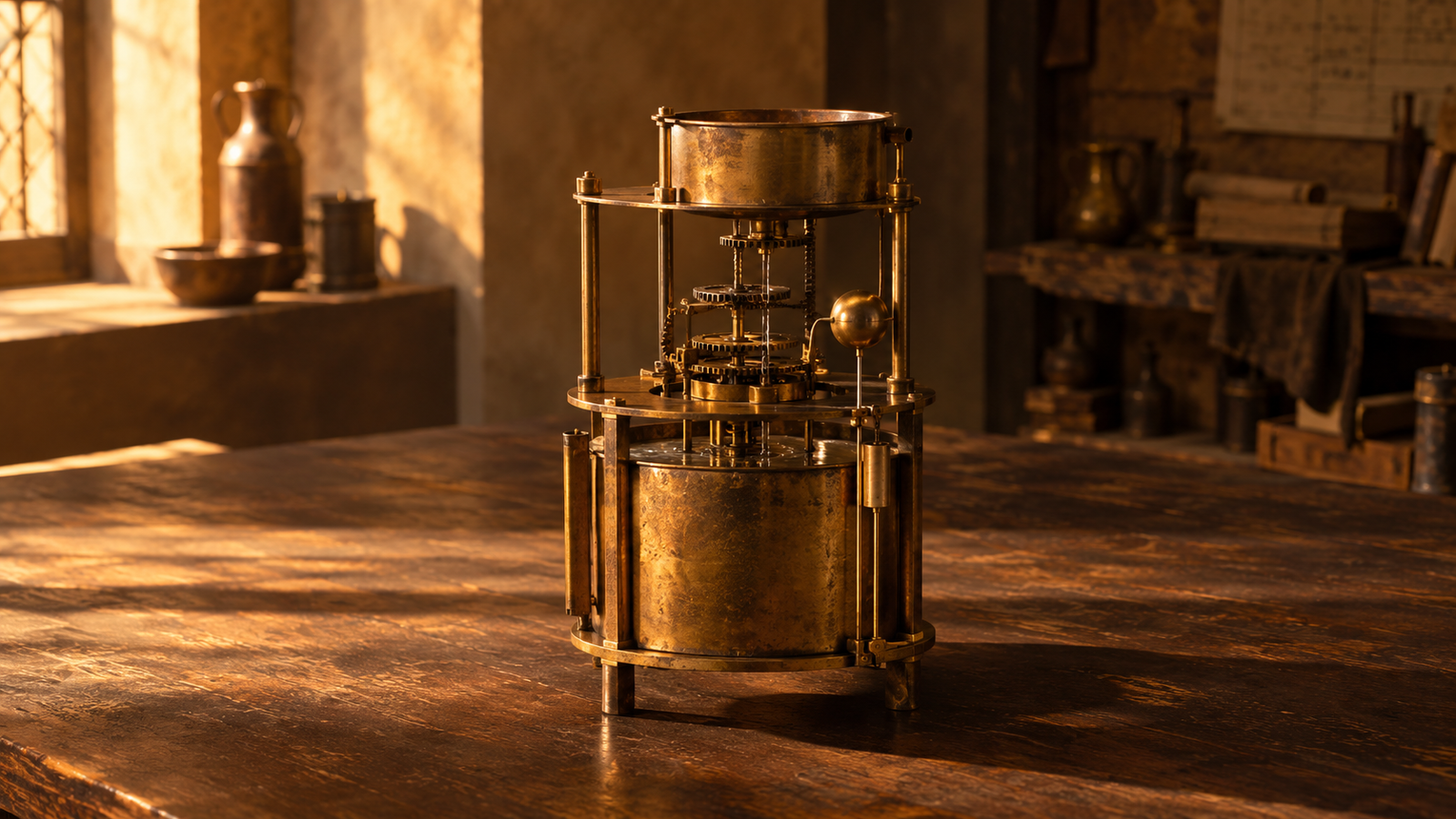
In ninth-century Baghdad, during the height of the Abbasid Golden Age, a trio of scholars known as the Banu Musa brothers published a masterwork titled the Book of Ingenious Devices. Within its pages were descriptions of over one hundred mechanical devices that operated automatically using fluid pressure, differential head height, and clever internal float valves. Three centuries later, engineer Ismail al-Jazari expanded upon this foundation in Upper Mesopotamia, building self-regulating water clocks, programmable musical automata, and double-acting liquid pumps. These scholars did not simply design novelty showpieces. They created the world's first automated feedback mechanisms, laying the mathematical and physical foundations for modern fluid power control systems and mechanical robotics.
The Physics of Siphons and Differential Pressure
The primary power source for medieval hydraulic engineering was water head pressure. Head pressure refers to the potential energy stored in a column of liquid due to the gravitational force pulling down on its total height. To control this energy without human intervention, the Banu Musa brothers mastered the physical mechanics of the siphon. A siphon is a bent tube that allows liquid to flow upward over the rim of a reservoir without a pump, driven entirely by hydrostatic pressure differences between the liquid surface and the discharge point.
By combining siphons with internal float valves, the Banu Musa engineered self-replenishing vessels that maintained constant liquid levels. A float valve consists of a buoyant chamber floating on the water surface connected to a conical stopper in the inlet pipe. When liquid levels drop, gravity pulls the float down, opening the inlet pipe to admit fresh water. As the reservoir fills, the rising float drives the stopper back into the pipe socket, cutting off liquid flow automatically. This simple mechanical feedback loop represents the earliest form of closed-loop control, a fundamental concept in modern industrial control systems.
Conical Valves and Trick Hydraulic Switching
Beyond constant-level reservoirs, the Banu Musa pioneered the use of conical valves as fluid switches. A conical valve features a precision-ground metal plug shaped like a cone that fits tightly into a matching tapered seat. When liquid flows through the valve, the position of the plug regulates fluid speed and directional routing.
By arranging multiple conical valves in series inside sealed vessels, the Banu Musa engineered trick vessels that could automatically alternate between discharging water, wine, or mixed fluids depending on how much liquid was poured into the vessel neck. The system relied on air pressure differentials created within locked internal chambers. As incoming liquid displaced air from one sealed compartment, the displaced air pressure forced a secondary internal conical valve to open, shifting the fluid path without external human input.
Al-Jazari and the Invention of Segmental Gears and Camshafts
In the late twelfth century, Ismail al-Jazari took hydraulic engineering from small-scale vessel feedback to heavy mechanical power transmission. Al-Jazari invented the segmental gear, which is a gear wheel that has teeth around only a portion of its rim rather than the entire circumference. By meshing a continuously rotating segmental gear with two opposing gear racks, al-Jazari converted continuous circular rotation into back-and-forth linear motion.
Al-Jazari applied this mechanism to build a double-acting reciprocating water pump. Driven by an overhead water wheel, the machine used segmental gears to drive two parallel copper pistons in alternating strokes. As one piston pulled back to draw water into a cylinder through a non-return inlet valve, the opposing piston pushed forward, forcing stored liquid through an outlet pipe into a elevated aqueduct. This marked the historical arrival of double-acting suction pumps, converting fluid movement directly into continuous mechanical work.
From Medieval Automation to Modern Industrial Control
Al-Jazari also introduced the camshaft to fluid control engineering. A camshaft is a rotating rod fitted with shaped offset projections called cams. As the shaft rotates, these cams strike levers at precise time intervals, opening water valves or triggering mechanical levers in a pre-programmed sequence. In al-Jazari’s famous automated musical boat, water falling at a steady rate over a sub-surface water wheel turned a central camshaft, which opened air valves to power internal mechanical flutes and drums in rhythmic patterns.
This integration of constant fluid pressure, mechanical feedback valves, and programmable camshaft timing meant that medieval hydraulic devices met the technical definition of modern programmable automata. The engineering principles established by the Banu Musa and al-Jazari traveled into Europe through trade routes and translation movements, eventually forming the bedrock of modern hydraulic machinery, steam engine governors, and automated liquid manufacturing plants.
The history of robotics was not born in the silicon era, but in the quiet flow of water guided by the brilliant mechanical minds of the medieval Islamic world.