Taming Economic Fluctuations: The Breakthroughs Behind the 2026 Nobel Prize in Economics
Team Ilm Ora · 15 October 2026
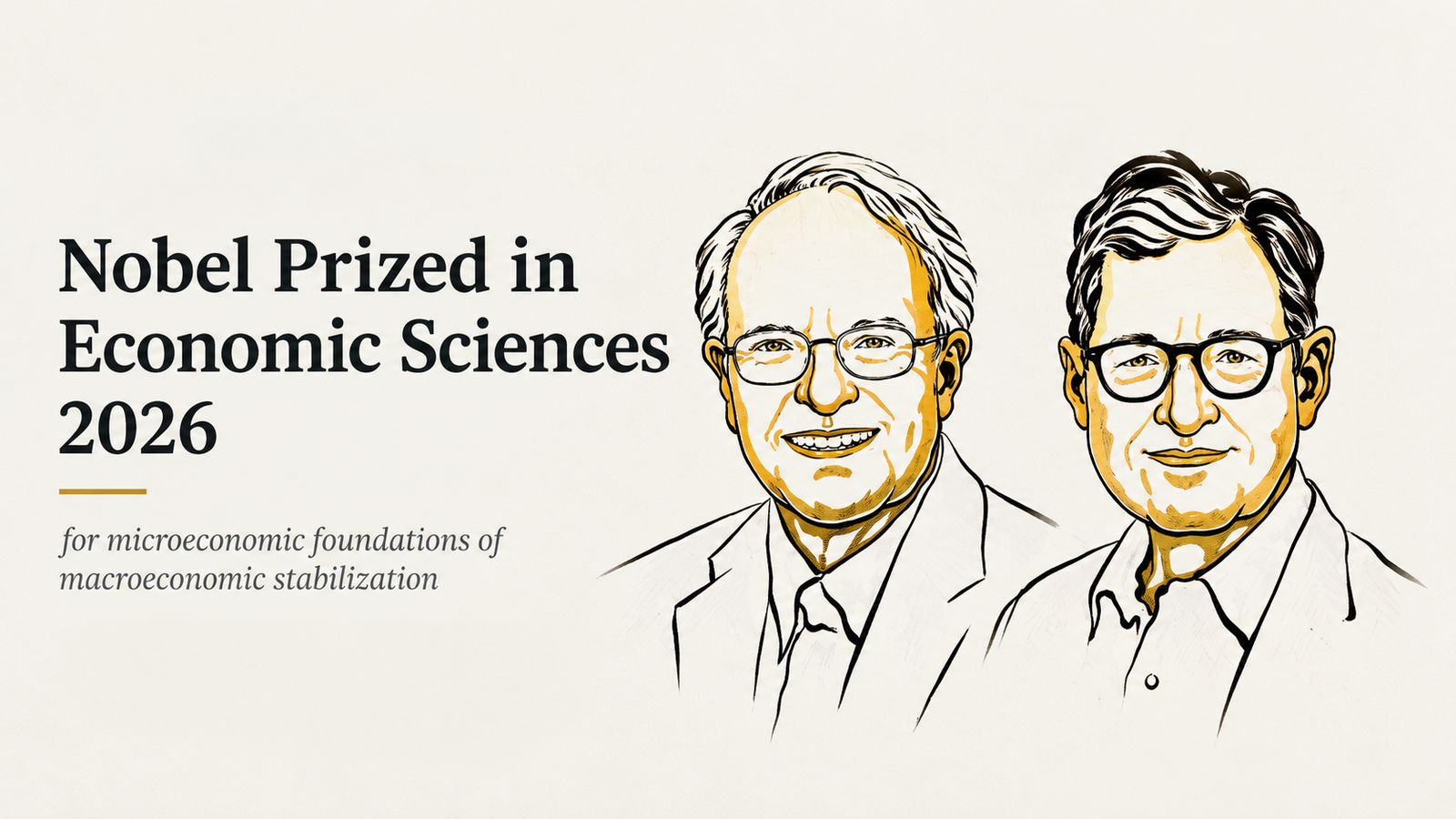
Modern economies routinely cycle through periods of intense expansion and painful recession, creating unpredictable shifts in employment, purchasing power, and industrial investment. On October 12, 2026, the Royal Swedish Academy of Sciences awarded the Sveriges Riksbank Prize in Economic Sciences to American economists Robert E. Hall of Stanford University and Michael Woodford of Columbia University. The pair was recognized for constructing the microeconomic foundations that explain macroeconomic stabilization policy, providing central banks and treasuries with mathematical models that bridge individual human decisions with national economic outcomes.
Bridging Individual Choices and National Markets
Historically, macroeconomics operated on aggregate numbers, treating national consumption, aggregate investment, and total inflation as sweeping forces independent of individual behavior. Hall and Woodford revolutionized this perspective by demonstrating that macroeconomic fluctuations are driven by microfoundations. Microfoundations refer to the mathematical modeling of individual economic agents, such as household consumers and business managers, who make forward-looking choices based on available information, prices, and expected future policies. Robert Hall pioneered the understanding of consumption dynamics by demonstrating that consumer spending behaves as a "random walk" under the rational expectations hypothesis. Rather than reacting strictly to current income, households base their daily purchases on their anticipated lifetime earnings. Consequently, sudden shifts in aggregate demand do not occur from minor fluctuations in wages, but from unexpected changes in long-term economic outlooks. His work forced economic planners to evaluate how households adjust their savings when interest rates shift.
Monetary Rules and the Mechanics of Inflation
Michael Woodford built upon these behavioral insights to construct modern New Keynesian macroeconomics, supplying the mathematical architecture used by central banks today. Woodford demonstrated that central banks control inflation not simply by adjusting the physical supply of money in circulation, but by setting short-term interest rates to guide future price expectations. Interest rates represent the cost of borrowing capital over time; raising them encourages saving and slows business spending, while lowering them stimulates market activity.
Woodford introduced the concept of inflation targeting, proving mathematically that a central bank can maintain economic stability without fixed monetary targets if it provides clear, transparent commitments about its future interest rate policy. When a central bank communicates its future intentions (a strategy known as forward guidance), businesses adjust their price lists and long-term contracts in advance. This alignment reduces price volatility and dampens violent swings in the business cycle.
The Real-World Impact on Government Policy
The models developed by Hall and Woodford directly inform how modern governments handle economic shocks, such as supply chain dislocations, financial panics, or sudden spikes in energy costs. When an economy faces a severe downturn, policymakers use these frameworks to calculate the exact timing and magnitude of fiscal stimulus (such as targeted tax cuts or infrastructure spending) and monetary interventions like interest rate reductions.
By grounding national policy in microeconomic realities, their work prevents central banks from overreacting to short-term disruptions, which historically caused deep recessions or run-away inflation. Today, virtually every major central bank relies on structural dynamic models built on the foundation Hall and Woodford established, ensuring that monetary decisions protect employment while keeping price levels stable.
Economic stability is not an accidental balance of market forces, but the calculated result of understanding how individual decisions shape our collective financial future.