
Is This Noah’s Ark? What the 2026 Durupınar Fieldwork Has and Hasn’t Shown
Team Ilm Ora · 15 October 2026
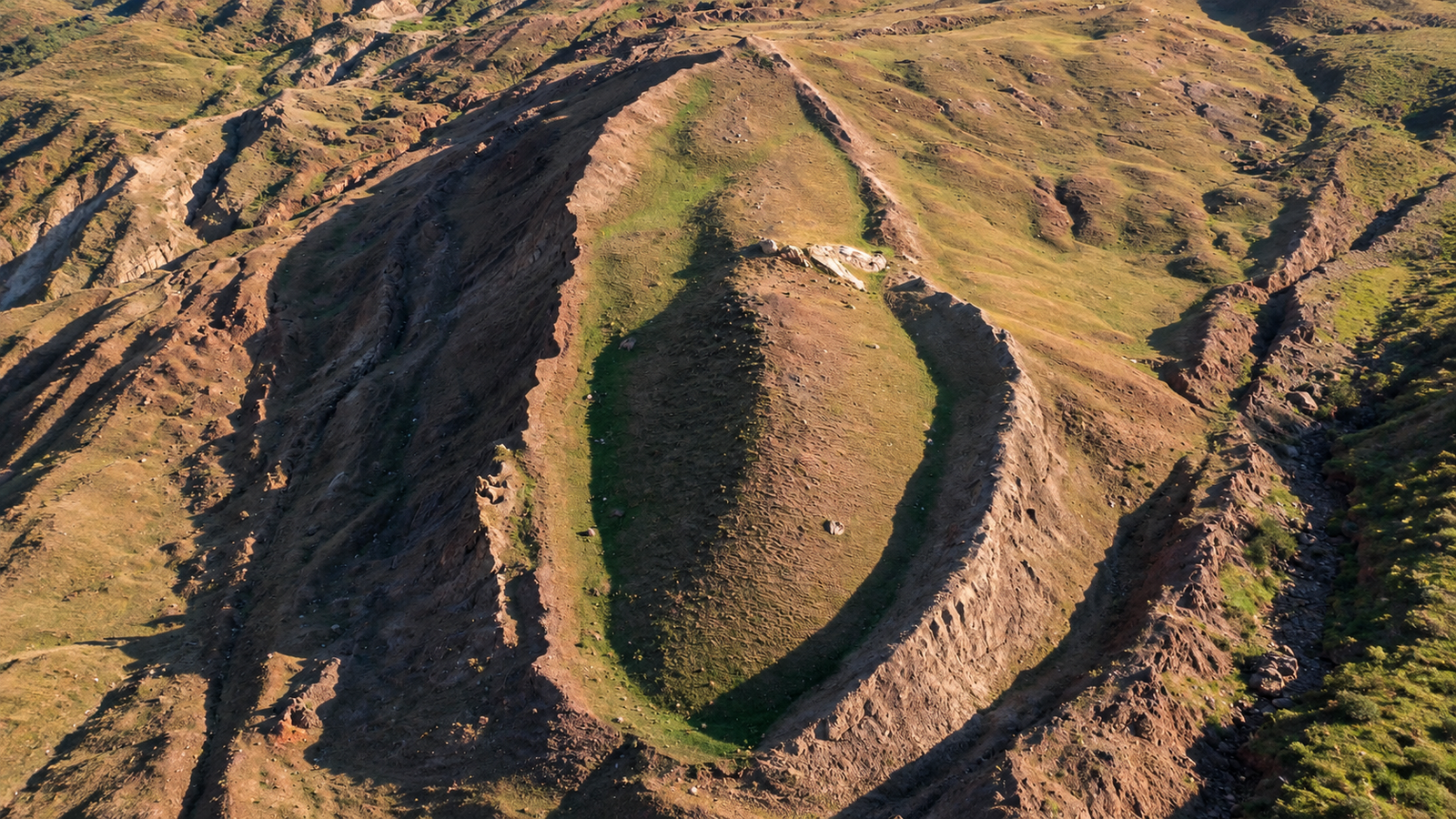
The Durupınar formation is a boat-shaped mound on Turkey’s Mount Ararat region that researchers have long explored as a possible resting place of Noah’s Ark. In 2026 it received its largest and most official investigation so far. By 15 October, the fieldwork was finished and the headlines were loud. The most important evidence, though, the laboratory results, won’t be ready until the winter. This article covers what has been announced, how each method works, and why none of it can settle the question yet.
What is the Durupınar formation?
The formation lies near the town of Doğubayazıt, about 29 kilometres south of Mount Ararat’s summit. A Turkish army captain named İlhan Durupınar spotted it in NATO mapping photographs in 1959, and LIFE magazine published a photograph in 1960. It is a long ridge of earth shaped roughly like a ship’s hull, about 157 metres (515 feet) long.
Why the “perfect length” is less perfect than it sounds
The length is the most repeated argument for the Ark theory. The Torah gives the Ark’s length as 300 cubits, and one rabbinic authority’s cubit of about 54 cm gives roughly 162 metres. A cubit was an ancient unit based on the forearm, and its length varied between cultures, roughly 45 to 56 cm. Another calculation using the Egyptian royal cubit of 52.4 cm gives 157 metres. Because the unit is uncertain, the “match” depends on which cubit you pick.
What the Quran says about where the Ark landed
The Quran’s account differs in two ways that matter here. In Surah Hud (11:44), the Ark settles on al-Judi. The Quran does not name Ararat, and it gives no dimensions for the Ark. The 300-cubit figure comes from Genesis 6:15, not from the Quran. A mountain called Cudi near the town of Cizre in southeastern Turkey carries the name, roughly 300 km from Doğubayazıt by map distance. Durupınar is near Ararat, a name that comes from the Biblical account. So even if the formation turned out to be a ship, the Quranic landing place would still be a separate question.
Seventy years of digging
1960: An American expedition dug for two days and found only soil and rock.
1977 onward: Amateur explorer Ron Wyatt revived interest, and radar scans by his associates reportedly showed walls. In 1987 a professional radar operator couldn’t reproduce them.
1988: Geophysicist John Baumgardner, once a supporter, drilled four holes and found mud and bedrock.
1996: Geologist Lorence Collins and former believer David Fasold published a paper calling the claim a hoax.
Geologists have generally described the site as a natural structure shaped by folding, erosion and landslide activity, including the regional Telçeker earthflow.
What the 2026 expedition actually did
This is not a lone enthusiast’s dig. The project has authorization from Turkish government agencies and is directed by Professor Cenker Atila of Sivas Cumhuriyet University’s archaeology department, in cooperation with the group Noah’s Ark Scans. About 20 scientists and students from five countries joined fieldwork that began on 29 June 2026. It was the first core drilling at the site since 1988, recovering samples from depths of up to 18 metres. The reported findings:
Radar: The university says scans found underground anomalies with relatively regular edges, including features that meet at right angles.
Carbon: Carbon levels inside the formation were about 40 percent higher than outside it. Drilling: A drill bit broke on a very hard layer about 4 to 5 metres down at one location. The team has suggested it may be petrified wood. Sample counts differ between reports. Coverage cites nearly 1,000 soil samples. A later university tally of the core and soil sampling programme said 366 samples.
New lead (12 October): Noah’s Ark Scans founder Andrew Jones said a separate archaeological site beside the formation will be investigated in a second season.
How each tool works, and what it can’t prove
Ground-penetrating radar (GPR). It sends short radio pulses into the ground and records the echoes. An echo happens wherever the material changes, such as soil to rock or soil to a gap. A “right angle” is a pattern in processed data, not a photograph. Natural rock often cracks along straight, perpendicular joints, so geometry alone doesn’t prove a human made it.
Soil carbon. Soil carries carbon from roots, rotted plants and carbonate minerals like limestone. More carbon fits buried wood, but it also fits other natural sources. It says something is different inside the formation, not what.
A broken drill bit. It tells us a layer is hard. Boulders, cemented rock and mineral crusts are also hard. Only examining the core can say what it is.
Radiocarbon dating. Living things absorb carbon-14, a radioactive form of carbon that decays at a known rate. Its half-life is about 5,730 years. Measuring how much is left dates when an organism died. A date would show that the wood was cut, but not that it was shaped into a ship.
Even supporters urge caution
The people running the project have been measured. The university describes its goal as determining whether the shape is entirely geological or shows evidence of human activity. Andrew Jones is a software developer who says openly that he is not an archaeologist, and none of the work has been peer reviewed. Even a Christian creationist organisation published a review urging readers to learn the background, including earlier investigations by qualified creationist scientists.
What happens next
The university aims to finish the planned investigations in 2027, with the first year’s findings published in a volume titled Durupınar Formation 2026 Research and presented in three international conference papers. The things to watch are independent radiocarbon dates, a description of the cores in a peer-reviewed paper, and whether other geologists can reproduce the radar results.
A boat-shaped hill is an invitation to ask a question, not an answer. Evidence arrives through measurement, publication and repetition, and faith in the story of Nuh (peace be upon him) never depended on a drill bit.