
Science
He Was Completely Blind. His Brain Was Still Watching.
Team Ilm Ora · 12 September 2026
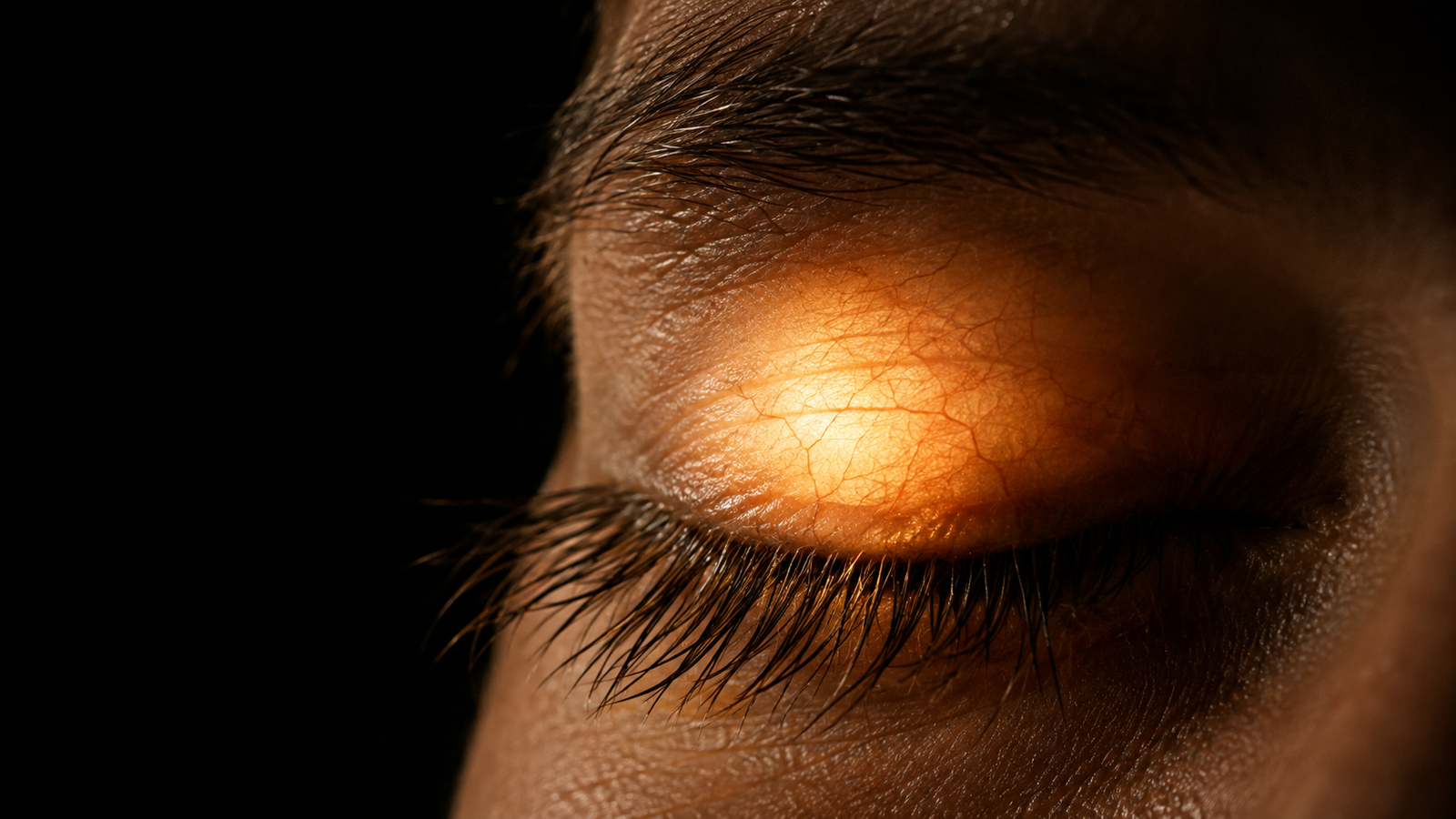
In 2008, researchers asked a completely blind man to walk down a hallway they had deliberately filled with obstacles, with no cane to help him. He didn't hit a single one — and afterward, he had no idea how he'd done it.
The Hallway Test
The man is known in scientific papers only by his initials, TN. Two strokes had destroyed the part of his brain responsible for conscious sight — called the primary visual cortex, or V1 — on both sides of his brain. This left him completely, permanently blind in the normal sense of the word. Ask him what he could see, at any moment, and the honest answer was always: nothing.
In a study led by researcher Beatrice de Gelder, TN agreed to walk down a hallway that the research team had deliberately filled with boxes, bins, and a camera stand, leaving his cane behind. He made it through the entire course without touching a single object — slowing down, shifting his path, and turning his body around obstacles smoothly, all while reporting that he was aware of absolutely nothing in front of him. The researchers made sure he wasn't just listening his way through: the hallway was silent, and small stationary objects like these don't reflect enough sound to navigate by echo anyway.
Something inside TN's brain clearly had detailed, accurate, real-time information about a cluttered room. TN himself, the conscious person having the experience, did not.
Naming the Paradox: A Scientist Named Weiskrantz, 1974
TN's case belongs to a well-documented phenomenon that scientists call blindsight, a term coined in 1974 by psychologist Lawrence Weiskrantz, based on his work with an earlier patient known as DB, who'd had part of his visual cortex surgically removed.
Weiskrantz used a method called "forced-choice testing" — basically, asking someone to guess, even when they swear they can't see anything. Using this method, his team found that DB could correctly say where an object was, which way it was pointing, and even roughly what shape it was, at rates far better than random guessing — despite DB insisting the entire time that he saw nothing at all. The name "blindsight" captures that exact contradiction: genuinely blind by every measure of subjective experience, but genuinely capable of seeing by every measure of actual test performance.
Later research split this into two flavors. In Type 1 blindsight, people report no visual awareness whatsoever, and only perform well when they're specifically told to guess. In Type 2 blindsight, people report a vague, hard-to-describe feeling that "something happened" in the area they can't see — without any actual visual quality to it — even while still insisting they didn't see anything.
Where Does the Signal Actually Go?
Here's the anatomical explanation, and it starts with a fact that surprises most people: your eyes don't send information down just one single pathway to your conscious awareness. When the visual cortex (V1) is destroyed, roughly half of the retina's output cells lose their main destination and shrivel away (a process called transneuronal degeneration). But that leaves the other half still fully working — and still sending signals somewhere.
Those surviving cells don't route through the now-broken pathway. Instead, they continue sending information to at least ten other separate structures deep in the brain — the thalamus, the hypothalamus, the midbrain — some of which then pass information along to higher visual processing areas, completely bypassing the destroyed visual cortex. Two specific detours have been studied the most:
The retinotectal pathway: signals travel straight from the eye to a midbrain structure called the superior colliculus (involved in eye movement and spotting things in your surroundings), which then relays information — mostly through a relay station called the pulvinar — onward to brain regions that specialize in detecting motion. The geniculo-extrastriate pathway: a separate detour through part of a structure called the LGN, which skips the destroyed visual cortex entirely and reaches higher visual brain areas directly.
Both of these detour routes are much older, evolutionarily, than the visual cortex itself. They're shared with animals that never evolved anything like a human visual cortex at all. In other words, blindsight isn't some weird malfunction — it's older visual wiring, wiring that likely did most of the heavy lifting for animals long before a visual cortex ever existed, stepping back up when the newer system goes down.
Reading Fear on a Face You Can't See
The story gets stranger with emotion. Researcher Alan Pegna tested whether TN could identify facial expressions — happy, scared, angry — shown in his blind field. Even though he kept insisting he was only guessing, TN identified the correct emotion far more often than chance would predict. Brain scans taken during the test showed his amygdala — the brain region most closely tied to processing fear and emotional significance — lighting up in response, even while his destroyed visual cortex stayed completely dark and inactive the entire time.
Follow-up research has mapped out a likely physical route for this: a pathway connecting the superior colliculus to the amygdala, passing through the pulvinar relay station, letting rough, low-detail emotional information reach the brain's fear-processing center without ever needing the machinery responsible for consciously "seeing" anything. This same route is thought to explain something researchers call affective blindsight — cortically blind people showing real physical and behavioral reactions to threatening facial expressions they insist they cannot see at all.
What TN's Brain Says About Every Brain
Blindsight itself is rare — it takes a very specific, severe kind of brain damage that most people will never experience. But researchers who study it point to something with much bigger implications: it proves, directly, that a large chunk of what your visual system does — spotting where things are, sensing motion, reading someone's expression, steering your body around an obstacle — can happen completely without producing any conscious visual experience at all. That's not a strange exception created by injury. It's a normal, standing feature of how vision works in every brain, sighted or not.
That raises a genuinely interesting question about your own, fully working eyes: these same older backup pathways are sitting there right now, active alongside your conscious vision. How much of your own split-second reactions — flinching before you consciously register something falling, noticing someone out of the corner of your eye before you know why you turned your head — are being handled by exactly this older, faster system, acting before whatever process gives you the actual felt experience of "seeing" ever catches up?
Roughly half of TN's optic nerve fibers survived the destruction of his visual cortex, quietly rerouting through pathways older than conscious sight itself — proof that a brain can navigate a room and read fear on a face without the part of it that ever gets to know any of it happened.